
Most people think of printers as quiet, fast, and capable of producing photo-like images. But not all printers fit that description. Impact printers are a different story — they use a mechanical striking action, much like a typewriter, to transfer ink onto paper. Despite being an older technology, impact printers remain important in industries where durability, reliability, and multi-copy printing matter more than speed or image quality.
For example, many banks still rely on dot matrix impact printers to update passbooks or print transaction slips. Retailers and logistics companies use them for invoices and shipping labels because they can produce multiple carbon copies at once.
This mechanical approach makes impact printers distinct from modern non-impact printers models like inkjet and laser, and that’s exactly why they continue to hold their ground in specialized environments.
What Are Impact Printers?
An impact printer is a type of printer that creates characters or images on paper by physically striking an inked ribbon against the surface, similar to how a typewriter works. This mechanical impact is what gives the technology its name. Unlike inkjet printers or laser printers that spray or fuse toner, impact printers rely on force to transfer ink, which makes them rugged and reliable for specific tasks.
The history of impact printing dates back to the mid-20th century when typewriters were widely used for office work. Early computers adopted similar mechanisms for printing text, leading to the development of devices like line printers and dot matrix machines. Over time, impact printers became a standard in industries that required fast, repetitive printing on continuous forms.
To better understand what makes impact printers unique, it helps to compare them with non-impact printers. While non-impact models excel in producing high-quality graphics silently, impact printers trade silence and finesse for durability, lower running costs, and the ability to print on multi-layer paper.
Table: Impact vs Non-Impact Printers
| Feature | Impact Printers | Non-Impact Printers |
|---|---|---|
| Printing Method | Mechanical striking of ribbon and paper | Ink spray (inkjet) or toner fusion (laser) |
| Noise Level | Noisy during operation | Quiet operation |
| Print Quality | Moderate, suitable for text/forms | High-quality text and images |
| Speed | Slower for detailed output, fast for forms | Generally faster for large volumes |
| Paper Handling | Continuous forms, carbon copies | Standard sheets |
| Cost Efficiency | Low cost for bulk forms | Higher consumable costs |
| Common Uses | Invoices, passbooks, shipping documents | Photos, reports, office documents |
How Impact Printers Work

At the core of an impact printer’s working principle is the idea of using force to transfer ink onto paper. The printer contains a print head that strikes an inked ribbon, which then presses the desired character or dot pattern onto the page. This mechanical action is what distinguishes impact printers from modern non-impact technologies.
When a print command is sent, the printer’s controller moves the print head horizontally across the paper while advancing the paper vertically at precise intervals. Each strike of the head leaves an impression, gradually forming letters, numbers, or graphics. The strength and precision of this mechanism allow impact printers to create multiple copies simultaneously if carbon paper is placed between sheets.
Although the basic principle is simple, the internal process involves several key components working together. These include the print head and pins, the ink ribbon and paper feed system, and the balance between mechanical striking and digital control.
Print Head and Pins
The print head is the most important component of an impact printer. In dot matrix printers, it consists of a series of pins—commonly 9 or 24—that strike against the ribbon. Each pin corresponds to a tiny dot on the paper. By firing different combinations of pins, the printer creates letters, numbers, and symbols. A higher pin count usually results in sharper and more detailed characters.
For example, a 9-pin printer produces text suitable for basic invoices and receipts, while a 24-pin model can generate text that is closer to “letter quality.” The movement of the print head is controlled by a stepper motor, which ensures precision as it travels horizontally across each line. This synchronization between the pins and motor allows the printer to maintain consistent output even at high speeds.
Over time, the design of print heads has evolved, but the principle has remained the same: a series of rapid strikes that convert digital instructions into physical impressions. This rugged simplicity explains why dot matrix print heads can last for years with minimal maintenance compared to inkjet nozzles or laser drums.
Ink Ribbon and Paper Feed
The ink ribbon is another essential part of the process. Positioned between the print head and the paper, the ribbon contains ink that is transferred whenever a pin strikes it. Unlike ink cartridges or toner, ribbons are inexpensive and can last for thousands of pages before needing replacement. This makes them highly cost-effective in environments where large volumes of text need to be printed daily.
The paper feed system works in tandem with the ribbon. Continuous forms, often with perforations and multiple layers, are advanced by tractor feeds that grip the holes along the edges of the paper. This ensures precise alignment and smooth progress of the paper, which is especially important when printing multi-copy forms with carbon paper.
Because of this design, impact printers excel at tasks that require durability rather than aesthetics. They can handle thick forms, multi-part documents, and continuous rolls that many modern printers would struggle with. For businesses dealing with shipping labels or invoices, this reliability makes them invaluable.
Mechanical Impact vs Digital Control
Although the striking mechanism of impact printers is mechanical, it operates under digital control. When a computer sends data to the printer, electronic circuits determine which pins should strike at each moment. This digital precision ensures that even though the action is mechanical, the results align perfectly with the input.
This combination of old and new technology is what makes impact printers unique. The mechanical impact guarantees that the print appears on every sheet, including carbon copies, while the digital logic allows flexibility in formatting and layout. For instance, the same dot matrix printer can print both plain text and simple graphics like barcodes or charts, thanks to its digitally controlled patterns.
The synergy between mechanical strength and digital accuracy has allowed impact printers to remain relevant in industries like finance, logistics, and government. While they may not rival the speed or quality of laser printers, their hybrid approach makes them reliable workhorses for specialized needs.
Types of Impact Printers
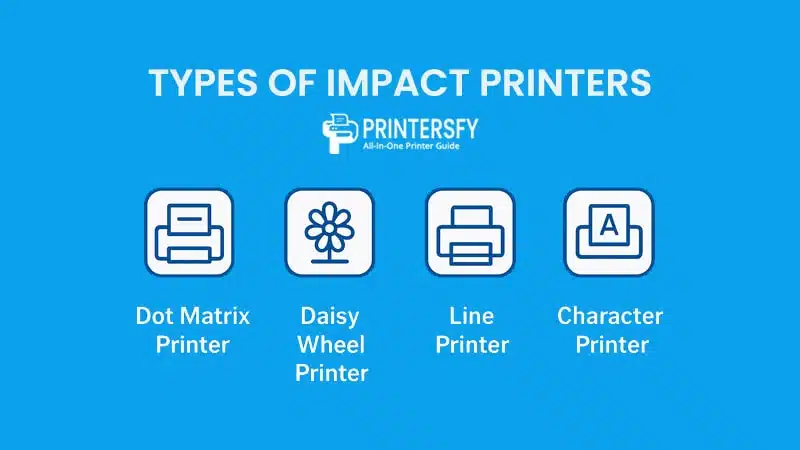
Although impact printers share the same principle of striking an ink ribbon, they come in different forms. Each type has its own design, speed, and use case. Below are the most recognized types of impact printers:
Dot Matrix Printer
The dot matrix printer is the most popular and widely used type of impact printer. It works by using a set of pins in the print head that strike against an ink ribbon to create patterns of dots on paper. These dots combine to form characters, numbers, or even simple graphics. Depending on the model, a dot matrix printer may use 9 or 24 pins, with higher pin counts producing sharper and clearer text.
One of the main advantages of dot matrix printers is their ability to print on continuous paper and multi-part forms. This makes them ideal for businesses that need carbon copies, such as banks, retail shops, and logistics companies. Even though their output quality is lower compared to inkjet or laser printers, dot matrix machines remain popular in environments where durability and cost efficiency are more important than aesthetics.
Another reason dot matrix printers are still in use today is their low running cost. The ribbons last longer than ink cartridges or toner, and the machines themselves are known to operate reliably in dusty or industrial settings where modern printers might fail.
Daisy Wheel Printer
A daisy wheel printer resembles the way a typewriter works. It has a wheel with molded characters (letters, numbers, and symbols) arranged around its circumference. When the printer receives input, the wheel rotates to the correct character, and a hammer strikes it against the ink ribbon, transferring a letter onto the paper.
Because the daisy wheel physically stamps each character, the print quality is very sharp—often called “letter-quality.” This made daisy wheel printers popular in the 1970s and 1980s for office documents where professional appearance was required. However, the speed of printing was quite slow, since the wheel had to rotate and strike for each individual character.
Despite their high-quality text output, daisy wheel printers had significant limitations. They could not print graphics or flexible font styles, and their mechanical design made them noisy. As non-impact printers like inkjet and laser became available, daisy wheels quickly declined in use.
Line Printer
The line printer was designed for high-speed printing, often used in large organizations and data centers. Unlike character-based printers, which print one symbol at a time, line printers can print an entire line of text simultaneously. This makes them extremely efficient for processing bulk data such as reports, invoices, and transaction logs.
There are different kinds of line printers, including drum printers and chain printers. Drum printers use a rotating drum with embossed characters, while chain printers employ a rotating chain of type characters. Both designs allowed the printer to strike entire lines of text quickly across wide sheets of paper.
Although line printers were once the backbone of business computing, their role has diminished with the rise of faster non-impact printers. Still, some industries continue to use them for batch processing and situations where massive print volumes are required.
Character Printer
A character printer prints one character at a time by striking the ribbon against the paper. It is one of the oldest forms of impact printers, serving as a bridge between typewriters and more advanced printing technologies. Early computer systems used character printers for simple text output and programming results.
The main advantage of character printers is their simplicity. They were relatively inexpensive and straightforward to operate, making them accessible in the early days of computing. However, their speed was extremely limited because each character had to be printed individually, which made them impractical for high-volume tasks.
Today, character printers are mostly obsolete, but they remain an important milestone in the history of printing technology. Understanding their role helps illustrate how printing evolved from mechanical typewriters into the modern digital devices we use today.
Comparison Between Types of Impact Printers
| Printer Type | Printing Method | Common Uses | Pros | Cons |
|---|---|---|---|---|
| Dot Matrix Printer | Print head strikes pins on ribbon | Invoices, multi-part forms | Cheap, durable, multi-copy | Noisy, low print quality |
| Daisy Wheel Printer | Wheel with embossed characters strikes | Letters, simple office docs | Clear text output | Very slow, limited fonts |
| Line Printer | Prints full line at once | Banking, billing, large reports | Fast, reliable | Bulky, limited graphics |
| Character Printer | Prints one character at a time | Early office use, forms | Simple design, robust | Extremely slow, outdated |
Advantages of Impact Printers
Impact printers may seem outdated compared to sleek inkjet or laser models, but they continue to offer specific advantages that keep them relevant in niche markets. Their durability, low operational costs, and ability to handle multi-part forms make them indispensable in environments where practicality outweighs presentation.
Durability and Rugged Performance
One of the most well-known strengths of impact printers is their ruggedness. Because they rely on simple mechanical components, they are less vulnerable to dust, heat, and humidity compared to inkjet or laser printers. This is why logistics companies and factories continue to rely on dot matrix machines for printing shipping labels or warehouse records.
In discussions on the r/printers subreddit, many IT technicians report that impact printers can run for years with minimal maintenance, often outlasting multiple generations of inkjet printers in the same workplace. Their simplicity and reliability make them ideal for demanding environments where downtime is costly.
Multi-Copy Printing with Carbon Paper
Another unique advantage of impact printers is their ability to produce multiple copies in a single print job. By using carbon paper between sheets, one strike from the print head can generate two or three copies of the same document. This feature is particularly valuable for banks updating passbooks, transportation companies issuing tickets, and government offices handling forms that require duplicate copies.
According to a Consumer Reports feature on legacy office devices, many small businesses in developing regions still choose dot matrix printers specifically for this functionality. Modern inkjet or laser printers cannot replicate it without additional hardware. This shows that impact printers maintain a niche advantage even in an era dominated by digital solutions.
Cost Efficiency in Long-Term Use
While modern printers often have hidden costs in the form of expensive cartridges or toner, impact printers remain cost-effective. Ink ribbons last for thousands of impressions and are significantly cheaper to replace. Paper costs are also lower since many organizations use continuous forms that reduce waste.
A report by IDC noted that in certain Southeast Asian markets, businesses still rely on impact printers for transaction slips and receipts because the total cost of ownership is much lower than replacing inkjet supplies. For companies with high-volume, low-detail printing needs, the long-term savings outweigh the limitations in print quality.
Limitations of Impact Printers

While impact printers are valued for their durability and cost efficiency, they also come with clear drawbacks. These limitations explain why most homes and modern offices have shifted to inkjet and laser models.
Noisy Operation
One of the most obvious disadvantages of impact printers is their noise. The constant striking of pins or hammers against the ribbon creates a noticeable clatter. In a quiet office, this can be disruptive, especially when printing long documents. Users often describe the sound as similar to an old typewriter, which is tolerable in an industrial setting but not in a modern workspace.
A user on a printer forum once joked that you can “hear a dot matrix printer from across the office,” highlighting how intrusive the noise can be. This drawback alone made many businesses switch to non-impact printers once affordable alternatives became available.
Limited Print Quality
Compared to today’s printers, impact printers offer limited resolution. Characters are often jagged, and detailed graphics are difficult to reproduce. Even a 24-pin dot matrix printer, which provides better text quality than a 9-pin, cannot match the sharpness of an inkjet or the professional finish of a laser printer.
For industries that rely on presentation—such as marketing or publishing—the lack of quality is a deal breaker. According to a PCMag review on legacy office hardware, businesses that needed high-quality reports or client-facing documents abandoned impact printers in favor of quieter, sharper models as soon as technology advanced.
Slower Speeds for Detailed Output
Although line printers are capable of high throughput for text, impact printers generally struggle when it comes to detailed layouts or graphics. Printing barcodes or forms with complex formatting takes longer because the machine must strike hundreds of tiny dots in sequence. This slows down productivity compared to a modern laser printer that can render the same page in seconds.
In industries where every minute matters, such as retail checkout or large-scale data processing, the slower speed becomes a limitation. That’s one reason why impact printers are now mainly reserved for specific tasks—like invoices or passbooks—where speed is less critical than reliability.
Real-World Uses of Impact Printers
Even though many offices have moved on to inkjet and laser devices, impact printers continue to serve specific roles where their unique strengths shine. From financial institutions to logistics companies, these machines remain relevant because of their reliability and low operational cost.
Banking and Financial Institutions
One of the most visible uses of impact printers today is in the banking sector. Passbook updating machines are almost always dot matrix-based because they can print multiple copies onto thick, pre-bound paper without jamming. For customers, this ensures that their transaction history is always up to date in physical form.
On r/printers, several users shared that banks prefer impact printers because “they just don’t die.” Even after decades of service, these machines still work reliably, something that’s rare with modern consumer printers. This experience shows how endurance outweighs aesthetics in industries that handle repetitive, high-volume printing tasks.
Retail and Point-of-Sale Systems
Impact printers are also common in retail environments, especially for receipts, invoices, and transaction slips. Because they can print on multi-part paper, stores often generate a customer copy and a merchant copy in a single print pass. This makes them highly practical for point-of-sale systems where speed and duplication are essential.
According to IDC market data, certain regions in Southeast Asia still see strong sales of dot matrix printers because small and medium businesses value their cost efficiency. Despite their noise and limited graphics, the ability to print duplicates keeps them indispensable in busy cash register environments.
Logistics and Industrial Settings
Warehouses, factories, and shipping companies also continue to depend on impact printers. These environments are often dusty, hot, and demanding—conditions where inkjet printers would clog or laser printers would require expensive maintenance. Impact printers, by contrast, keep functioning reliably.
In many logistics companies, impact printers handle waybills, delivery receipts, and inventory forms. A supply chain manager quoted by TechRadar explained that “dot matrix printers survive conditions where modern printers simply can’t.” This highlights the trust businesses place in tried-and-tested hardware when uptime is critical.
Future of Impact Printers in the Digital Age
Although impact printers are no longer the mainstream choice, they have not completely disappeared. Their future lies in niche roles where their durability and unique capabilities still provide value. Instead of being replaced outright, they are gradually becoming specialized tools for industries that need reliability over aesthetics.
Niche Relevance in Specialized Industries
Impact printers are unlikely to return to everyday office desks, but they remain essential in certain fields. Banking, logistics, and retail continue to rely on them for tasks like passbook updating, multi-copy forms, and receipt printing. These are functions where inkjet or laser printers either fall short or become too expensive to maintain.
According to Consumer Reports, many small businesses keep older dot matrix units running simply because “they do the job without fuss.” This highlights a future where impact printers may never fully disappear but instead survive as dependable workhorses in specific industries.
Compatibility with Digital Transformation
As companies digitize their workflows, some might expect impact printers to vanish altogether. However, many organizations still need hard copies of critical documents—especially in regions where paper records remain legally binding. For example, government forms, medical documents, and shipping receipts often require multiple copies, which impact printers can produce efficiently.
Users on Reddit’s r/printers community often point out that even in a “paperless office,” backups and official forms still require printouts. This suggests that impact printers, while old-fashioned, align surprisingly well with hybrid digital-paper workflows.
Market Outlook and Longevity
While sales of impact printers have declined globally, research by IDC shows that emerging markets in Asia and Africa still sustain demand. The cost-per-page advantage and rugged design make them attractive for businesses operating on tight budgets. In other words, they may no longer grow, but they are not vanishing anytime soon.
Tech analysts often describe impact printers as “legacy hardware that refuses to die.” Their future is not about innovation but endurance, serving industries that value reliability over cutting-edge features. This longevity shows that while their role is shrinking, it is also remarkably stable.
Comparison with Modern Printers

While impact printers still hold value in specific niches, their differences from modern printers—like inkjet and laser—are significant. Looking at speed, print quality, cost, and use cases helps explain why each type serves different markets.
Speed and Efficiency
Modern printers like laser models are far superior in terms of speed, especially when producing large volumes of clean text or graphics. For example, a typical office laser printer can push out 20–30 pages per minute, while a dot matrix printer may only manage a few lines per second.
That said, impact printers are designed for endurance, not speed. Businesses that need continuous printing for hours—such as in billing departments—still find them reliable. A logistics manager on Reddit’s r/printers mentioned that while “the print speed is ancient, the machine can run non-stop without jamming,” which highlights their durability over raw performance.
Print Quality and Versatility
If image clarity and professional presentation are priorities, inkjet and laser printers win without question. They can produce sharp graphics, high-resolution photos, and full-color prints—capabilities that impact printers simply cannot match.
Impact printers are limited to basic text and simple characters. As PCMag notes, they are “function-first devices,” meaning they serve tasks where looks don’t matter. This makes them ideal for utility printing but unsuitable for marketing materials or polished business documents.
Cost Considerations
Modern printers often have a higher initial price but lower long-term costs depending on usage. Ink tank printers, for example, are increasingly popular because of their low cost per page. In contrast, impact printers usually have low upfront and running costs but are less efficient for bulk high-quality printing.
According to IDC market data, businesses in Southeast Asia still hold onto impact printers precisely because of these savings. The replacement ribbons are cheap, and the machines can last decades with proper care. For small shops printing invoices or receipts, that kind of cost control matters more than crisp resolution.
Use Case Scenarios
The clearest difference lies in intended use. Inkjet and laser printers dominate homes, schools, and offices where quality and speed matter. Impact printers, however, fill a narrow but essential role in industries that require durability and multi-part forms.
In short, each category has its place. A hospital may use laser printers for medical records but still rely on impact printers for multi-copy patient forms. This coexistence shows that impact printers are not obsolete—they are just highly specialized compared to their modern counterparts.
Comparison with Modern Printers
| Criteria | Impact Printer | Inkjet Printer | Laser Printer |
|---|---|---|---|
| Print Quality | Low, text-focused | High, photo-capable | Very high, sharp text |
| Speed | Slow to moderate | Moderate | Fast |
| Noise | Very noisy | Quiet | Quiet |
| Cost per Page | Low (cheap ribbons) | High (expensive ink) | Moderate (toner efficient) |
| Durability | Very durable, long-lasting | Moderate | High |
| Typical Use | Invoices, forms, receipts | Home, photo printing | Office, bulk printing |
Dua tabel ini SEO-friendly karena:
Conclusion
Impact printers may no longer dominate the market, but they remain an important tool in certain industries. Their ability to handle multi-part forms, operate in tough environments, and keep costs low ensures they are still relevant even in a world filled with sleek inkjet and laser machines.
From banks still printing passbooks to logistics companies generating delivery slips, impact printers continue to prove their worth where durability matters more than presentation. As one business owner shared on Reddit, “it might sound old-school, but nothing else can do what these machines do for our workflow.” This kind of real-world reliance explains why impact printers refuse to disappear.
Looking ahead, modern printers will continue to dominate most consumer and office spaces. Yet, impact printers will remain the quiet workhorses of specialized sectors—valued not for their looks, but for their function.
FAQs About Impact Printer
What is the impact printer?
An impact printer is a type of printer that produces characters or images by physically striking an ink ribbon onto paper, similar to how a typewriter works.
What are the four types of impact printers?
The main types include dot matrix printers, daisy wheel printers, line printers, and character printers—each designed for specific printing needs.
What are the characteristics of impact printers?
They are durable, cost-effective, capable of multi-part form printing, and relatively noisy compared to modern non-impact printers.
Do impact printers use ink?
Yes, but instead of cartridges, they use ink-soaked ribbons. This makes them cheaper to maintain compared to inkjet printers.
Why are impact printers still used?
They remain popular in industries like banking, logistics, and healthcare where carbon-copy documents and long-lasting reliability are essential.