
Specialized printers rarely come to mind when people think about printing. The default image is still a compact inkjet on a desk, used for documents, forms, or the occasional photo. That assumption feels harmless, but it quietly flattens a much broader reality. Printing today operates far beyond the boundaries of home and small office use.
Across business, retail, creative studios, and technical environments, printing has become a functional requirement rather than a convenience. Labels need to be produced continuously and consistently. Receipts must print instantly without interruption. Photographs demand predictable color, not approximation. Engineering drawings require scale and precision that standard formats cannot provide. In these settings, the printer is no longer an accessory. It is part of the process itself.
As printing tasks have become more specific, the tools behind them have changed. Instead of asking whether a printer can handle many different jobs, organizations now focus on whether it can handle one job reliably, every time. This shift has brought specialized printers into sharper focus. These devices are designed around defined tasks, not general expectations. Their value lies in consistency, durability, and alignment with real workflows.
Market data reflects this transition. According to Fortune Business Insights, the global printers market was valued at USD 51.96 billion in 2024 and is projected to reach USD 65.49 billion by 2032. That growth is not driven by casual printing. It is driven by professionals and businesses investing in equipment that matches how printing is actually used.
Specialized printers come into focus once printing is seen as a function rather than a feature. When output becomes part of a workflow—rather than an occasional task—the logic behind purpose-built devices starts to feel less abstract and far more practical.
What Are Specialized Printers?
Specialized printers are printers designed to perform specific printing tasks that go beyond the capabilities of standard consumer models. Rather than focusing on flexibility, they are built around a clearly defined role, whether that role involves printing labels, receipts, large-format drawings, photographs, textiles, or high-volume transactional output.
The defining characteristic of specialized printers is intention. Every major design decision reflects how and where the printer will be used. A label printer assumes continuous roll media and repetitive output. A photo printer prioritizes color consistency and fine detail. A large format printer accepts physical size as a constraint in exchange for accuracy and scale. In each case, the printer is not trying to serve a broad audience. It is trying to serve one use case well.
Compared with standard printers, the difference is not simply performance. It is focus. Consumer printers are expected to handle a mix of documents, images, and occasional heavier tasks. As a result, they rely on compromises. Media handling is generalized, print speed fluctuates, and long-term consistency is secondary to convenience. Specialized printers remove many of those compromises by narrowing their scope.
This is why specialized printers often appear less versatile on paper. They may support fewer media types or lack features that seem standard elsewhere. In practice, those limitations are deliberate. By limiting what the printer needs to handle, manufacturers can reinforce durability, precision, and reliability where it matters most. Over time, this focus reduces errors, downtime, and variability in output.
In commercial and industrial contexts, the term specialty printers is sometimes used interchangeably to describe the same category of devices. The wording varies, but the concept remains consistent. These printers are defined not by what they can do occasionally, but by what they are built to do repeatedly, under real operational conditions.
Understanding what specialized printers are requires stepping away from feature lists and thinking in terms of purpose. Once the task is clear, the design choices begin to make sense. This perspective also explains why these printers occupy a different role than standard office equipment and why they continue to gain relevance across industries.
Why Specialized Printers Exist
This category of printers exists for several practical reasons that consistently appear across different printing environments.
The Limits of Standard Printers
Standard printers are designed to be flexible. That flexibility is useful in environments where printing is occasional and varied. It becomes a limitation when printing turns into a core activity. Media compatibility, volume tolerance, and output consistency are the first areas where general-purpose devices begin to struggle.
Sheet-fed paper handling works well for documents but breaks down when labels, rolls, thick media, or oversized formats are involved. Print engines designed for intermittent use degrade faster under continuous workloads. Color output that looks acceptable for casual use becomes unpredictable when accuracy matters. These issues are not flaws. They are consequences of design priorities.
As printing demands increase, users often attempt to compensate by upgrading within the same category. They choose faster models, higher resolutions, or larger trays. Eventually, those incremental improvements stop solving the underlying problem. The printer is still operating outside the conditions it was designed for.
Purpose Over Versatility
Specialized printers exist because there is a point at which versatility becomes inefficient. In professional environments, reliability and repeatability matter more than optional features. A printer that performs one task consistently is easier to integrate into workflows, easier to maintain, and easier to predict.
This philosophy drives the design of specialized printers. Instead of supporting every possible scenario, they are optimized for one. Print paths are simplified. Components are reinforced for higher duty cycles. Software controls align with specific workflows rather than generic use. The result is not a printer that does more, but a printer that fails less.
In practice, this focus reduces friction. Operators spend less time adjusting settings. Output becomes more predictable. Maintenance follows clearer patterns. Over time, these advantages outweigh the loss of flexibility. For businesses and professionals, the printer becomes a stable part of the process rather than a variable within it.
The existence of specialized printers reflects how printing is actually used today. As tasks become more defined and expectations rise, purpose-built tools offer a clearer path forward than general solutions stretched beyond their limits.
What Makes a Printer “Specialized”
The distinction between general-purpose devices and specialized printers is shaped by more than a single design choice. It emerges from how printing systems are expected to perform once they are placed into regular, demanding use.
How Specialized Printers Work (Conceptual View)

Specialized printers work by narrowing their scope. Instead of accommodating a wide mix of occasional tasks, the entire system is organized around producing one type of output as efficiently and consistently as possible. This focus influences not only the print technology itself, but also how jobs move through the printer from start to finish.
At a conceptual level, the workflow is simplified to remove variability. Media enters the printer in a predictable form, follows a controlled path, and exits with minimal adjustment required. Software settings are optimized to repeat the same operation reliably, rather than adapt to frequent changes. Over time, this consistency reduces operator involvement and lowers the chance of errors.
The logic behind this approach becomes clearer when the workflow is viewed as a system rather than a sequence of mechanical steps.
Workflow Stage How Specialized Printers Approach It Job input Designed around a single or narrow job type Media feeding Optimized for specific media formats and paths Print process Tuned for repeatability over flexibility Output handling Focused on consistent alignment and finish Operator intervention Minimal once settings are established
This system-level optimization explains why specialized printers tend to feel stable under sustained use. They are not reacting to changing conditions. They are repeating a known process with as few variables as possible.
Core Characteristics
Across different categories, specialized printers share a set of recurring characteristics. One of the most visible is media-specific design. These printers are built to handle materials that standard devices treat as edge cases, such as continuous rolls, thick substrates, textiles, or large-format sheets. The media defines the printer’s behavior from the outset.
Duty cycle and reliability are equally central. Specialized printers are expected to operate for longer periods without degradation. Components are selected with sustained use in mind, which leads to more predictable performance over time. In professional environments, consistency often matters more than raw speed.
Form factor and operating environment further separate these printers from consumer models. Many are larger, louder, or less compact. These traits are not oversights. They reflect where the printer is meant to live: on production floors, behind counters, in studios, or in technical rooms where function outweighs convenience.
Characteristic What It Means in Practice Media-specific design Built around defined materials and formats High duty cycle Intended for continuous or repeated operation Reliability focus Prioritizes consistency over versatility Purpose-driven form factor Sized and built for professional environments
Together, these characteristics explain why specialized printers rarely feel interchangeable with standard devices.
Key Components (High-Level Only)
At the component level, specialized printers differ from general-purpose devices in ways that are structural rather than intricate. The goal is not to introduce complexity, but to ensure that each printer part supports a narrowly defined task with minimal variation over time.
The print mechanism is selected based on what needs to be repeated consistently. Some printers rely on thermal elements designed for fast, inkless output. Others use ink systems optimized for color stability rather than speed. What matters is not the technology itself, but how well it holds up under repetition.
Media handling systems follow the same logic. Instead of accommodating many formats, they are built around one or two predictable paths. Roll-fed mechanisms, reinforced rollers, and fixed alignment points reduce the need for constant recalibration. This stability directly affects output consistency.
Control electronics and firmware complete the system. Rather than offering extensive customization, they prioritize predictable behavior. Settings are meant to be established once and reused, allowing the printer to operate as part of a larger workflow rather than as an interactive device.
Component Area Role in Specialized Printers Print mechanism Chosen for repeatability and task-specific output Media handling system Simplified paths to reduce alignment variation Structural components Reinforced for sustained operation Control electronics Focused on stability rather than feature breadth Firmware logic Designed for consistent, repeatable workflows
This approach is widely recognized in professional printing environments. According to Mimeo, commercial printers use specialized techniques and printing equipment to handle high-volume and complex print jobs. That observation highlights a broader principle: specialization works by reducing uncertainty at every level of the system.
When viewed together, these components explain why specialized printers behave less like adaptable gadgets and more like dependable tools. Each part plays a defined role, and the system as a whole is designed to repeat the same task reliably without constant adjustment.
Main Types of Specialized Printers

This category of printers spans a wide range of environments, each defined by a different relationship between output, workflow, and reliability. What connects them is not a shared technology, but a shared design approach. Each type exists because a general-purpose printer struggles to operate efficiently once certain conditions become routine rather than occasional.
The differences between these printer types are easiest to see when they are examined individually. Each one reflects a specific compromise between flexibility and consistency, shaped by how printing is expected to function in practice.
Label Printers
Label printers are built around repetition. Unlike sheet-based printers that treat each job as a separate event, label printers assume that printing will happen in sequences, often without pause. This assumption influences not only how media is handled, but how the entire system behaves during extended use.
How Label Printers Work
Most label printers rely on roll-fed media that moves through a fixed and predictable path. Labels are printed continuously and separated through cutting mechanisms or tear-off points once output is complete. Because the media format rarely changes, alignment and tension can be maintained without constant recalibration.
This continuous printing logic reduces the friction between jobs. Instead of restarting the print process each time, the printer remains in motion, ready to produce the next label almost immediately. Over long runs, this stability becomes more valuable than raw speed.
Core Functions and Use Cases
In logistics, shipping, and inventory management, labels function as identifiers rather than documents. They connect physical items to tracking systems, databases, and workflows that depend on consistency. A misaligned or delayed label can disrupt scanning, sorting, and delivery processes downstream.
For these environments, reliability outweighs versatility. Label printers are expected to perform the same task repeatedly with minimal variation, often in spaces where printing is only one part of a larger operation.
Why They Are Considered Specialized
Label printers are considered specialized because both their media and workflow dependencies are narrow. They are not designed to switch between formats or tasks. Their value lies in predictability. Once integrated into a system, they operate as a fixed component rather than an adaptable tool, which is a role standard printers are not designed to fill.
Thermal Printers
Thermal printers approach printing with a different set of priorities. By removing traditional ink or toner systems, they simplify operation and reduce the number of variables that can interrupt output.
Thermal Printing Technology Explained
Thermal printing relies on heat rather than liquid ink. In direct thermal printing, heat-sensitive media darkens when exposed to a heated printhead. In thermal transfer printing, heat transfers ink from a ribbon onto the media surface. While the mechanisms differ, both methods eliminate the need for ink cartridges or toner.
This design choice changes how the printer behaves in daily use. With fewer consumables to manage, setup time is reduced and maintenance becomes more predictable.
Key Characteristics
One of the defining characteristics of thermal printers is inkless operation. Without liquid ink, there is less risk of clogging, drying, or leakage. Output is produced quickly, often immediately after a job is received, which makes these printers well suited to time-sensitive environments.
Speed and simplicity also affect reliability. Thermal printers tend to perform consistently over long periods, especially when printing the same type of content repeatedly. This makes them a common choice in settings where delays or inconsistencies have operational consequences.
Receipt Printers
Receipt printers represent a highly focused application of thermal printing. Their design reflects the demands of transactional environments, where printing must occur instantly and repeatedly throughout the day.
Relationship with Thermal Printers
Most receipt printers are built on thermal printing technology, sharing the same core principles. The difference lies in how narrowly the printer is optimized. Receipt printers are designed to handle short bursts of text, rapid job repetition, and immediate availability without warm-up time.
Visual quality is secondary. The primary requirement is legibility delivered at speed, with minimal user intervention.
Real-World Usage
In retail and hospitality, receipt printers operate as part of point-of-sale systems rather than as standalone devices. A delay or failure affects not only printing, but the entire transaction flow. For this reason, receipt printers are built to be simple to load, easy to service, and tolerant of frequent handling.
Their specialization lies in how tightly they are bound to a specific workflow. Once installed, they perform a single function repeatedly, which is why they remain distinct from other thermal printer categories.
Photo Printers
Photo printers occupy a different position among specialized printers. Instead of prioritizing speed or simplicity, they focus on visual accuracy and consistency.
Color Accuracy Over Speed
Photo printers are designed to reproduce color with a high degree of precision. Pigment ink systems are often used to achieve stable results across multiple prints, reducing variation caused by light, humidity, or paper differences. The print process is slower, but each pass is controlled carefully.
Media sensitivity is central to this design. Paper type, coating, and texture directly influence output, and photo printers are built to account for these variables rather than ignore them.
Who Uses Photo Printers
Photographers, studios, and proofing environments rely on photo printers when printed output serves as a reference rather than a final product. In these settings, the printer is part of a decision-making process. The goal is not speed, but trust in what the print represents.
This emphasis on predictability over throughput is what places photo printers firmly within the category of specialized printers.
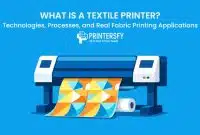
Textile Printers
Textile printers address a category of printing where paper is no longer the default medium. Their design reflects the challenges that emerge once ink must interact with fabric rather than a coated sheet.
Printing on Non-Paper Media
Printing on textiles introduces variables that standard printers are not designed to manage. Fabric absorbs ink differently depending on fiber type, weave, and treatment. Instead of sitting on the surface, ink often penetrates the material, which affects sharpness and color density. Textile printers are built with these behaviors in mind, using controlled ink delivery and curing processes to stabilize results.
The workflow also differs. Media handling systems must accommodate flexible, sometimes uneven surfaces without causing distortion. This requirement shapes both the mechanical design and the pace at which printing occurs.
Key Applications
Textile printers are commonly used in fashion production, merchandise creation, and creative industries where customization matters. They support short runs and on-demand output, allowing designs to move quickly from concept to physical form. Their specialization lies in how closely they align printing technology with material behavior rather than forcing fabric to behave like paper.
Large Format Printers (Plotters)
Large format printers, often referred to as plotters, specialize in scale. Their defining feature is not speed or volume, but the ability to produce accurate output at sizes that standard printers cannot accommodate. These printers exist for environments where visual proportion, alignment, and surface coverage matter more than how quickly a page is produced.
Size as a Specialization
Large format printers are designed to handle oversized media, often in roll form. This requires reinforced carriages, precise movement control, and stable feeding systems to maintain alignment across wide surfaces. As output size increases, even minor inconsistencies become more visible, which is why accuracy consistently takes precedence over throughput.
The physical presence of these printers reflects their purpose. They are built to occupy space because scale demands it. In production settings, size is not a drawback but a requirement tied directly to the output they are expected to deliver.
Technical and Visual Output
Plotters are widely used for CAD drawings, GIS maps, architectural plans, and signage. In commercial printing environments, this category also includes flex printers and other signage printers designed for continuous output on flexible media. Flex banner printer, for example, relies on large format systems that can maintain consistency across long runs without distortion.
In these contexts, scale carries meaning. A line’s position, proportion, and continuity affect how information is read or how a visual message is perceived. Large format printers exist to preserve that relationship across technical drawings and visual displays alike, making them essential tools in both engineering and signage-focused workflows.
A3 Printers
A3 printers sit at an interesting boundary between standard and specialized devices. On paper, they resemble larger versions of office printers. In practice, their role often shifts once printing requirements change.
When A3 Becomes “Specialized”
For small businesses and creative environments, A3 printers often represent the first step away from standard formats. The ability to print larger layouts, visuals, or marketing materials introduces new workflows that standard A4 printers cannot support efficiently.
Once larger output becomes routine rather than occasional, the printer’s role changes. Media handling, space requirements, and consistency expectations begin to resemble those of more specialized devices. In this context, A3 printers move beyond convenience and take on a more focused function.
A2 Printers
A2 printers push further into professional territory. Their size and operating requirements place them firmly outside casual use.
Professional-Only Territory
A2 printers are typically used for technical drawings, engineering documentation, and visual presentations where scale and clarity are essential. Their operation assumes a controlled environment and a clear purpose. As a result, flexibility is limited in favor of stability and accuracy.
This specialization is reflected in how these printers are integrated into workflows. They are not shared devices. They serve defined roles within technical or creative processes, reinforcing their position as specialized tools rather than general equipment.
Specialized Printers vs Standard Printers
The distinction between specialized printers and standard printers becomes clearer when their roles are compared directly. While both produce printed output, they are designed around different assumptions about how printing fits into daily use.
Standard printers prioritize flexibility. They are expected to handle a variety of tasks with minimal setup, often in environments where printing is occasional. Specialized printers prioritize consistency. They are designed to perform the same task repeatedly under predictable conditions.
This difference affects everything from media handling to maintenance expectations. Standard printers aim to accommodate change. Specialized printers aim to minimize it.
Aspect Standard Printers Specialized Printers Media Sheet paper Media-specific Volume Low–medium Medium–high Flexibility High Task-focused Maintenance Basic Purpose-driven
In practice, neither category replaces the other. Each serves a different role. Standard printers remain useful where versatility matters. Specialized printers become essential where printing is part of a larger, repeatable process. Choosing between them depends less on specifications and more on how printing is expected to function day after day.
Who Uses Specialized Printers

Specialized printers tend to appear wherever printing moves from an occasional task into a recurring requirement. Their users are defined less by industry labels and more by how closely printing is tied to daily operations.
Small Businesses
For small businesses, specialized printers often emerge out of necessity rather than scale. A packaging business that prints shipping labels throughout the day, or a café that relies on continuous receipt output, quickly reaches the limits of general-purpose equipment. In these settings, specialized printers provide consistency without demanding constant attention. They allow owners to focus on running the business instead of troubleshooting devices that were never designed for sustained use.
Retail and Logistics
Retail and logistics environments rely on speed and predictability. Labels, receipts, and tracking information must be produced accurately and on demand. Specialized printers fit into these workflows as fixed components, expected to operate reliably across long shifts. Their role is functional rather than visible, yet disruptions are immediately felt when output slows or stops.
Creative Professionals
In creative fields, printing often serves as a reference point rather than a final step. Photographers, designers, and studios use specialized printers to evaluate color, scale, and layout with confidence. The emphasis is not on throughput, but on trust. When output becomes part of the creative decision-making process, general-purpose devices introduce too much uncertainty.
Technical & Engineering Fields
Technical and engineering disciplines rely on printers for precision rather than presentation. Large drawings, schematics, and scaled visuals demand accuracy that standard printers struggle to maintain. Specialized printers in these environments are treated as instruments. Their output informs decisions, measurements, and approvals, which places a premium on reliability and consistency.
Things to Consider Before Choosing a Specialized Printer
Selecting a specialized printer involves more than matching features to a task. Because these devices are designed around specific workflows, small mismatches can have outsized effects over time.
Print Volume and Duty Cycle
Print volume determines how hard a printer will be pushed on a daily basis. Specialized printers are built with defined duty cycles in mind, allowing them to operate continuously without rapid wear. Choosing a device that aligns with actual volume prevents premature degradation and reduces maintenance interruptions.
Media and Consumables
Media type shapes almost every aspect of printer behavior. Roll-fed labels, thermal paper, textiles, and large-format sheets each require different handling and consumables. Availability and cost matter just as much as compatibility. A printer that depends on hard-to-source media can introduce friction into otherwise efficient workflows.
Space, Power, and Environment
Specialized printers often assume environments that differ from home or small office settings. Larger footprints, higher power demands, and noise levels are common trade-offs. Evaluating space and environmental conditions early helps avoid compromises that undermine long-term usability.
Learning Curve and Workflow
Finally, workflow alignment matters as much as technical capability. Some specialized printers require operators to adopt new habits or software routines. The learning curve is not a drawback if it leads to stability, but it should be acknowledged upfront.
Consideration Why It Matters Media type Determines compatibility Volume Affects durability Space Physical feasibility Skill level Operator efficiency
Choosing the Right Tool for the Job
Specialized printers are not upgrades in the traditional sense. They do not replace standard printers so much as redefine what printing is expected to do. Their value lies in alignment rather than performance alone.
When printing becomes predictable, repeatable, and central to a workflow, general-purpose solutions begin to feel strained. Specialized printers address that strain by narrowing their focus and strengthening reliability. They trade flexibility for consistency, and convenience for control.
Viewed this way, the decision is less about specifications and more about fit. The right printer is the one that disappears into the workflow, doing its job quietly and repeatedly. In that role, specialized printers function not as impressive devices, but as dependable tools—built to serve a purpose, and built to keep doing so over time.
FAQs About Specialized Printers
What makes a printer “specialized”?
A specialized printer is designed around a specific task rather than general use. Its hardware, media handling, and workflow are optimized for consistency instead of flexibility.
Are specialized printers better than standard printers?
They are not better in general, but better suited for certain jobs. When printing becomes frequent or mission-critical, specialized printers offer more reliability.
Can specialized printers replace regular office printers?
In most cases, no. They usually complement standard printers by handling tasks that general devices struggle to support efficiently.
Are specialized printers harder to use?
Some require a short learning curve, but day-to-day operation is often simpler because settings rarely change once configured.
Who should consider using specialized printers?
Businesses, professionals, and technical teams should consider them when printing is part of a repeatable workflow rather than an occasional activity.