
For most people, the biggest frustration with owning a printer isn’t the machine itself—it’s the cost of ink. Buying replacement cartridges often feels more expensive than buying the printer, especially if you print frequently. This is where the continuous ink supply system (CISS) comes in, offering an alternative that has completely changed how many users approach printing.
A continuous ink supply system printer uses refillable tanks connected to the printhead through small tubes. Instead of replacing cartridge every time they run out, you refill the tanks with bottled ink, which is cheaper and lasts longer. Many users know these machines simply as CISS printers, and they’ve quickly become popular among students, small businesses, and offices that need to manage printing costs without sacrificing quality.
The concept of a continuous ink supply system isn’t new, but in recent years it has become mainstream thanks to brands like HP, Epson, and Canon introducing factory-ready models. These are often marketed as “tank printers” or “EcoTank printers,” and they provide a more reliable experience compared to older DIY printer CISS systems that users had to install themselves.
Beyond cost savings, printers with CISS offer higher page yields, making them ideal for bulk printing such as reports, marketing materials, and academic projects. At the same time, they reduce plastic waste from disposable cartridges, which has made them attractive to eco-conscious consumers.
In this complete guide, we’ll explore what a continuous ink supply system printer is, how it works, the different types available, its pros and cons, and how it compares to other printing systems like cartridges and laser printers. We’ll also highlight some of the best printers with continuous ink system technology currently available, along with tips to help you choose and maintain one. By the end, you’ll have a clear understanding of whether CISS printing is the right solution for your needs.
What is a Continuous Ink Supply System (CISS)?
A continuous ink supply system (CISS) is a printing technology designed to replace the traditional cartridge model with a more efficient, refillable ink tank system. Instead of using small cartridges that need frequent replacement, a CISS printer relies on external tanks connected directly to the printhead. These tanks are continuously supplied with ink through tubes, ensuring a steady flow during the printing process.
The main advantage of a continuous ink system printer lies in its efficiency. Because the ink tanks are much larger than standard cartridges, users can print thousands of pages before needing a refill. This makes it highly attractive for people who print in bulk, such as small business owners, schools, or students working on research projects.
Modern printers with CISS systems are no longer limited to third-party modifications. In the past, many users installed aftermarket kits to convert their cartridge-based printers into CISS systems for printers. However, these often came with risks like leakage, compatibility problems, or voided warranties. Today, leading brands like HP, Epson, and Canon manufacture factory-built continuous ink system printers, providing reliability, support, and consistent performance.
From a technical perspective, CISS in printers ensures a balanced ink supply by using airtight tubing systems that prevent air bubbles and clogging. This makes the printing process smoother and reduces the chances of common cartridge-related issues. The ink reservoirs are also transparent, so users can easily monitor ink levels without relying on printer software alerts.
Another reason why CISS printing is gaining traction is cost-effectiveness. Ink bottles for printers with continuous ink supply systems are significantly cheaper than cartridges. A single refill set can last for months, even in a high-volume environment. Compared to cartridge printers, where cost per page is notoriously high, CISS printers can lower running costs by up to 80%.
However, affordability doesn’t mean compromising on quality. A well-maintained continuous ink supply printer can deliver sharp text and vibrant colors comparable to traditional inkjet printers. This combination of quality, efficiency, and low running costs is why CISS systems are now considered the future of inkjet printing.
In short, a continuous ink supply system eliminates the biggest frustrations of cartridge printing: high costs, frequent replacements, and waste. By offering higher yields, smoother operation, and eco-friendly refilling, CISS printers represent a smart choice for anyone looking for reliable long-term printing.
How Does a Continuous Ink Supply System Work?
Understanding how a continuous ink supply system (CISS) operates makes it easier to see why it’s considered a game-changer in modern printing. Unlike cartridge-based systems that rely on frequent replacements, printers with CISS systems are designed for seamless ink delivery over long periods of use.
At its core, a continuous ink system printer consists of four main components: external ink tanks, tubes, printhead, and the printer’s internal control system. These printers parts work together to ensure that ink flows smoothly without interruption. Let’s break it down step by step.
External Ink Tanks
The foundation of the CISS system printer is its external ink tanks. These tanks are significantly larger than standard cartridges, holding enough ink to produce thousands of pages. They are usually transparent, allowing users to easily check ink levels at a glance.
Refilling is done using affordable ink bottles, which are spill-resistant and eco-friendly compared to disposable cartridges.
Tubing System
Connecting the tanks to the printhead is a network of airtight tubes. This is where the “continuous” part of continuous printer ink systems comes into play.
The tubes deliver ink consistently, ensuring that the printer doesn’t run dry mid-job. Advanced designs prevent air bubbles, which can cause clogging and print quality issues.
Printhead and Flow Control
Once the ink travels through the tubes, it reaches the printhead. This is where the precision happens—tiny nozzles spray ink onto the paper in exact patterns.
The printer’s internal sensors regulate the flow, so the printhead only uses the amount needed. This efficiency not only reduces waste but also enhances print consistency.
Monitoring and Maintenance
One of the biggest advantages of CISS printers is their self-monitoring capability. Modern models, like the HP Smart Tank printer or Epson EcoTank, include sensors that detect ink flow irregularities.
Some even offer software integration, giving users real-time updates about ink usage. Maintenance is minimal—occasional cleaning cycles ensure the tubes and nozzles remain unclogged.
Workflow of a Continuous Ink Supply System
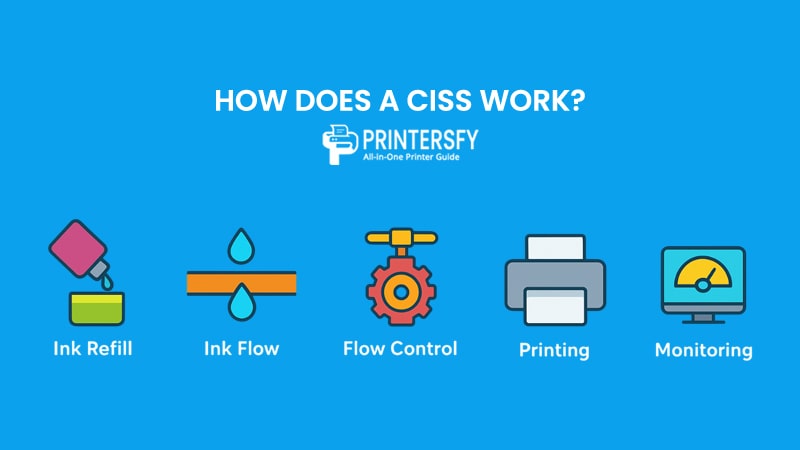
Here’s a simplified breakdown of how the system works from start to finish:
Step Process Description 1 Ink Refill User fills external tanks with bottled ink. 2 Ink Flow Tubes transport ink from the tanks to the printhead. 3 Flow Control Sensors regulate the supply to prevent overflow or shortages. 4 Printing Printhead sprays ink onto paper with high precision. 5 Monitoring Transparent tanks and software alerts help track ink usage.
In essence, CISS printing combines large ink reservoirs with smart delivery technology. This ensures that printing is not only cost-efficient but also smooth and reliable. By eliminating the need for constant cartridge swaps, a continuous ink supply printer gives users more freedom to focus on printing tasks rather than maintenance.
Main Types of Continuous Ink Supply System
Like most printing technologies, the continuous ink supply system (CISS) comes in different variations, each designed to suit specific printing needs. By understanding these types, users can make better decisions when choosing a printer with a CISS system for personal or business use.
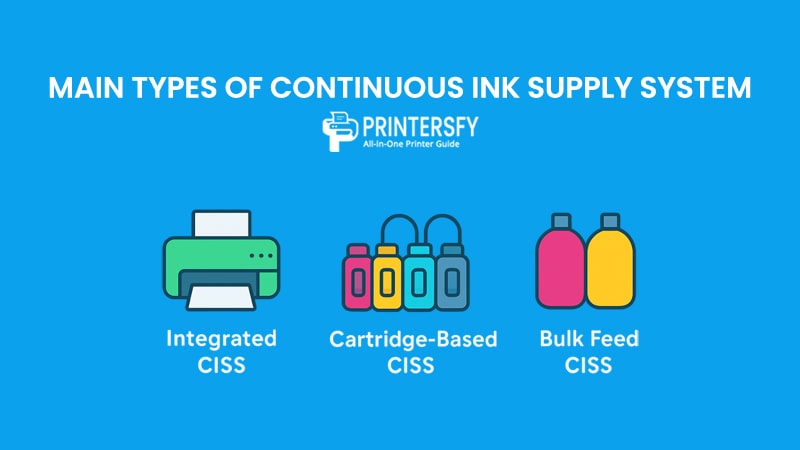
Integrated CISS
The integrated continuous ink system is built directly into the printer by the manufacturer. Examples include the HP Smart Tank series and Epson EcoTank printers. These models are factory-designed with external ink tanks, ensuring airtight tubing, reliable ink flow, and warranty support.
- Pros: Reliable performance, minimal risk of leaks, manufacturer warranty remains valid.
- Cons: Slightly higher upfront cost compared to regular cartridge printers.
- Best For: Home offices, schools, and businesses that want a worry-free printing experience.
Cartridge-Based CISS
This version modifies traditional cartridge printers by attaching refillable cartridges to external tanks. Known as a cartridge-based CISS system, it gained popularity before integrated CISS printers were widely available.
- Pros: Affordable upgrade for existing printers, compatible with many older models.
- Cons: More prone to leaks or clogging, may void manufacturer warranty.
- Best For: Users on a budget who want to convert their cartridge printer into a CISS printer.
Bulk Feed CISS
Designed for high-volume environments, the bulk feed continuous ink system uses large-capacity tanks to hold massive amounts of ink. These tanks connect to the printer via durable tubing, making it suitable for commercial printing operations.
- Pros: Lowest cost per page, ideal for businesses with large print demands.
- Cons: Requires more space, higher maintenance, not suitable for casual users.
- Best For: Print shops, graphic design firms, and offices producing thousands of pages monthly.
Main Types of Continuous Ink Supply System (CISS) Explained
| Type | How It Works | Pros | Cons | Best For |
|---|---|---|---|---|
| Integrated CISS | Built-in tanks designed by manufacturer | Reliable, leak-free, warranty safe | Higher initial cost | Offices, schools, home users |
| Cartridge-Based CISS | Modified cartridges linked to external tanks | Affordable, works with older models | Leak risks, warranty void | Budget-conscious users |
| Bulk Feed CISS | Large tanks with high-volume ink feed | Extremely low running costs | Space & maintenance heavy | Commercial printing |
Table: Comparison of Main Types of Continuous Ink Supply System (CISS)
By breaking down these CISS types, it’s clear that not all systems are created equal. An integrated CISS printer offers peace of mind, a cartridge-based system appeals to tinkerers and budget users, while a bulk feed CISS is the powerhouse for professional printing setups. Choosing the right system depends on balancing cost, reliability, and scale of printing.
Advantages of Using a Continuous Ink Supply System
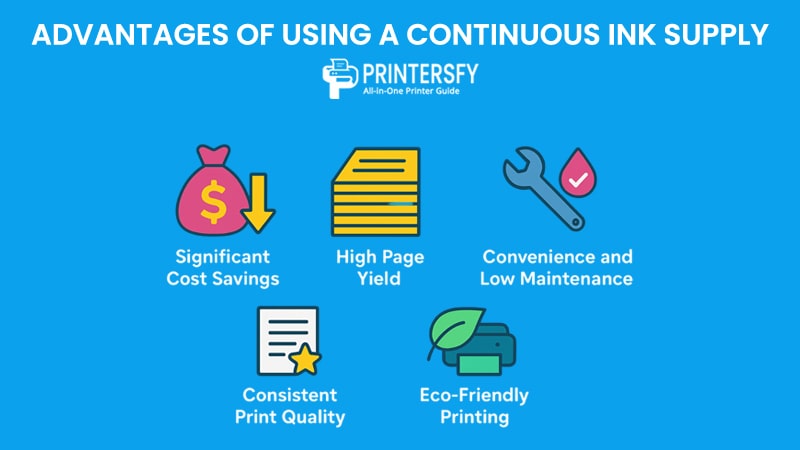
For many users, switching from traditional cartridges to a continuous ink supply system (CISS) feels like a major upgrade. The appeal lies in lower running costs, ease of use, and consistent performance. Let’s dive deeper into the key benefits of CISS printers.
Significant Cost Savings
The biggest advantage of a printer continuous ink system is cost efficiency. Standard cartridges are notoriously expensive, often costing nearly as much as the printer itself. With a continuous printer ink system, ink is supplied in affordable bottles, cutting printing costs by as much as 70–90%. Over time, this makes CISS system printers much more economical.
Real-world example: A business printing 1,000 pages per month could spend hundreds of dollars annually on cartridges. With a CISS printer, the same workload might cost less than half.
High Page Yield
Printers with CISS systems can produce thousands of pages before needing a refill. Where a standard cartridge may only yield a few hundred pages, a continuous ink supply printer can handle 5,000 to 10,000 pages or more on a single tank refill.
This makes them ideal for schools, offices, and small businesses that rely on heavy printing.
Convenience and Low Maintenance
One underrated benefit of a CISS in printer setups is convenience. Transparent tanks let users easily monitor ink levels, and refilling takes just a few minutes.
Unlike cartridges, which often require multiple replacements each month, CISS printers can go months without interruption. Less frequent refills also mean reduced downtime and fewer emergency trips to buy ink.
Consistent Print Quality
Because CISS printing delivers a steady flow of ink, print quality remains consistent over time. Issues like fading, streaking, or uneven color—common with nearly empty cartridges—are much less likely.
Continuous supply ensures that the printhead is always adequately fed, improving both reliability and longevity.
Eco-Friendly Printing
Another major plus is sustainability. Cartridges generate significant plastic waste, especially when used in high-volume environments.
CISS ink systems rely on refillable tanks and bottles, which drastically reduce waste and environmental impact. For businesses and schools aiming to adopt greener practices, printers with continuous ink systems are a natural fit.
Advantages of CISS Printers Over Traditional Cartridge Printers
| Feature | CISS Printers | Cartridge Printers |
|---|---|---|
| Cost per Page | Very low (up to 90% cheaper) | High |
| Page Yield | Thousands per refill | Hundreds per cartridge |
| Convenience | Easy refill, long intervals | Frequent replacements |
| Print Quality | Consistent, steady flow | Can fade/streak as cartridge empties |
| Eco-Friendliness | Less plastic waste | Significant cartridge waste |
Table: Advantages of CISS Printers Compared to Traditional Cartridge Printers
When it comes to value, reliability, and sustainability, CISS printers clearly outperform traditional cartridge-based systems. For anyone printing frequently—whether at home, in a classroom, or in a business setting—switching to a continuous ink supply printer is a smart move.
Disadvantages of Continuous Ink Supply System
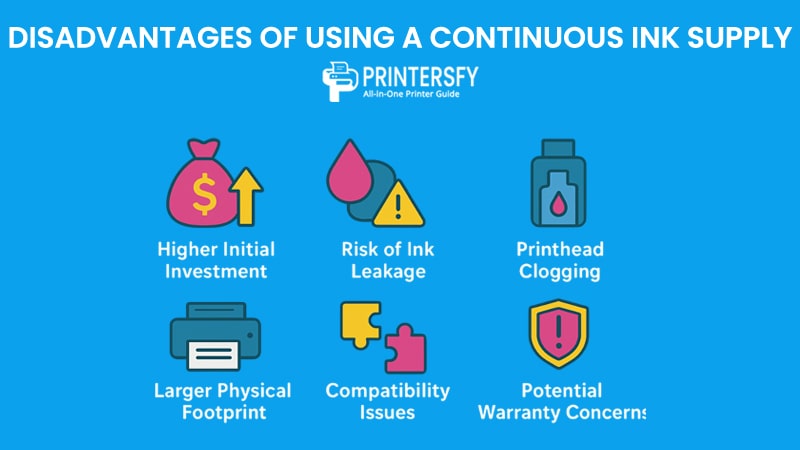
While CISS printers bring impressive benefits, they’re not without trade-offs. Understanding the potential downsides helps users decide if a continuous ink supply system truly fits their needs.
Higher Initial Investment
A printer with continuous ink system usually costs more upfront compared to traditional cartridge models. For example, HP Smart Tank or Epson EcoTank printers can be priced significantly higher at purchase. However, the long-term savings on ink often offset this cost. For casual users who print only occasionally, the initial expense may not feel justified.
Risk of Ink Leakage
One common complaint from early adopters of CISS systems—especially cartridge-based models—is leakage. Because the ink travels through tubes, improper installation or rough handling can cause spills. Even integrated systems like the HP Smart Tank printer or EcoTank printer HP need careful refilling to avoid mess.
On forums such as r/printers, users often share stories of ink stains on desks after incorrect refills. This highlights the importance of following the manufacturer’s guidelines.
Printhead Clogging
Since CISS printing involves constant ink flow, it’s crucial to keep the printer in regular use. If left idle for long periods, ink can dry and clog the printhead. Unlike cartridges, which are replaced with a fresh printhead each time, continuous ink supply printers rely on cleaning cycles or manual maintenance to fix clogs.
Larger Physical Footprint
Because CISS ink systems include external or built-in tanks, these printers often take up more space than cartridge-based printers. For home users with limited desk space, this could be inconvenient. Bulk-feed CISS printers, designed for heavy-duty work, require even more room.
Compatibility Issues
While printers with continuous ink supply system are becoming more mainstream, they may not always support advanced printing features, especially in specialized graphics or photo printing. Professional users who need color accuracy at the highest resolution sometimes find PostScript drivers with cartridge systems more reliable.
Potential Warranty Concerns
Integrated systems like HP Smart Tank and Epson EcoTank maintain manufacturer warranties. However, users who retrofit third-party CISS for printer kits onto cartridge printers risk voiding their warranty. This makes choosing between factory-integrated and aftermarket systems a critical decision.
Limitations of CISS Printers Compared to Cartridge Printers
| Drawback | CISS Printers | Cartridge Printers |
|---|---|---|
| Initial Cost | Higher upfront | Lower upfront |
| Leakage Risk | Possible with poor handling | Rare |
| Printhead Maintenance | Needs regular use | Replaced with cartridge |
| Space Requirement | Larger (due to tanks) | Compact |
| Warranty Issues | Risk with third-party kits | Usually covered |
Table: Disadvantages of Continuous Ink Supply System Compared to Cartridge Printers
In short, CISS system printers deliver excellent cost and convenience benefits, but they aren’t ideal for everyone. Occasional users, those with tight space, or people wary of maintenance may still prefer cartridge-based printers.
Continuous Ink Supply System vs Other Ink Systems
Choosing the right printer often comes down to the type of printer ink system it uses. While printers with continuous ink supply system (CISS) are gaining popularity, they’re not the only option. Traditional cartridges, integrated ink tank printers such as the EcoTank printer HP, and laser printers with toner cartridges all have their own strengths. Let’s compare them side by side.
CISS vs Traditional Cartridges
Cartridge printers have long been the standard in homes and offices. However, they come with high ink costs and frequent replacements. In contrast, a CISS printer offers bulk ink refills, dramatically reducing cost per page.
- Cost Efficiency: CISS printers can lower printing expenses by up to 90%, while cartridge-based printers are notorious for high running costs.
- Print Quality: Both can deliver sharp documents, but cartridges often maintain better color accuracy for photos.
- Best Use Case: Cartridges suit occasional users who print only a few pages per month, while CISS printers are ideal for frequent or heavy use.
- Maintenance: Cartridges require constant replacements, whereas CISS systems demand occasional refilling and clog prevention.
CISS vs Ink Tank Printers
This comparison can be tricky because an ink tank printer, such as the HP Smart Tank printer or EcoTank printer HP, is essentially an integrated version of a CISS system printer. Both rely on refillable tanks, but the difference lies in who installs the system.
- Cost Efficiency: Both offer similar low running costs, but factory-integrated ink tank printers are optimized for reliability.
- Print Quality: Ink tank printers usually have better factory calibration, ensuring consistent results compared to DIY cartridge-based CISS kits.
- Best Use Case: For home and office environments, ink tank printers are generally the safer choice due to warranty support and lower leakage risk.
- Maintenance: Ink tank models require minimal user intervention beyond refills, whereas third-party CISS kits can demand more attention.
CISS vs Laser Printers (Toner-Based)
Laser printers take a completely different approach, using toner powder instead of liquid ink printers. They are known for speed, durability, and sharp text quality. Compared to CISS printing, however, laser printers can be more expensive for color output.
- Cost Efficiency: For black-and-white printing, laser printers are competitive. But for color, continuous ink supply printers remain far cheaper.
- Print Quality: Laser printers excel at text sharpness, while CISS printers provide better color depth for photos and graphics.
- Best Use Case: Laser printers are ideal for offices that primarily print documents in high volumes, while CISS systems suit environments needing both text and vibrant color output.
- Maintenance: Toner cartridges last longer than ink refills, but replacing them can be costly. CISS tanks require more frequent attention but are much cheaper to refill.
CISS vs Cartridge, Ink Tank, and Laser Printers: Key Differences
| Ink System | Cost Efficiency | Print Quality | Best Use Case | Maintenance |
|---|---|---|---|---|
| Continuous Ink Supply System (CISS) | Very low cost per page (up to 90% savings) | Strong color printing, consistent quality | Heavy home & office printing, schools, SMEs | Regular refills, prevent clogs |
| Traditional Cartridges | High running costs | Good text & photo accuracy | Light or occasional users | Frequent replacements |
| Ink Tank Printers (HP Smart Tank, EcoTank HP) | Low cost per page | Consistent factory calibration | Reliable home & office use | Simple refills, low risk |
| Laser Printers (Toner-Based) | Low for B/W, high for color | Excellent text, average color | High-volume office documents | Long-lasting toner, expensive replacement |
Table: Continuous Ink Supply System vs Cartridge, Ink Tank, and Laser Printers
In short, while printers with continuous ink supply system shine in affordability and balanced performance, ink tank printers like the HP Smart Tank printer offer manufacturer-backed reliability, and laser printers dominate text-heavy office work. The right choice depends on your print volume, type of documents, and long-term budget.
Popular Printers with CISS
The popularity of printers with CISS (Continuous Ink Supply System) has skyrocketed in the last decade, thanks to their ability to cut printing costs and boost productivity. Brands like HP, Epson, and Canon have invested heavily in this segment, offering consumer-friendly devices that combine affordability with reliability. Below are three of the most popular series: HP Smart Tank, Epson EcoTank, and Canon MegaTank.
HP Smart Tank
HP has long been a dominant player in the printing industry, and its HP Smart Tank series reflects a commitment to efficiency and ease of use. Unlike third-party CISS modifications, Smart Tank printers are designed and optimized at the factory level, ensuring consistent ink flow and long-term durability.
- Key Features: Wi-Fi connectivity, app-based management, and seamless compatibility with smartphones and PCs.
- Page Yield: Up to 6,000 black-and-white pages and 8,000 color pages per refill.
- Strengths: HP Smart Tank printers offer user-friendly maintenance, reliable performance, and wide ink availability.
- Best Use Case: Families, students, and small offices that need affordable and consistent printing without the hassle of third-party modifications.
Epson EcoTank
The Epson EcoTank series is often considered the pioneer of factory-integrated CISS printers. With large refillable tanks and ultra-high-yield bottles, Epson positioned EcoTank as the ultimate alternative to expensive cartridges.
- Key Features: Extremely low running costs, precision core printheads, and strong photo-printing capabilities.
- Page Yield: Some models exceed 7,500 pages in black and 6,000 in color on a single refill set.
- Strengths: Reliability, huge ink savings, and strong market presence in both consumer and business segments.
- Best Use Case: EcoTank printers are ideal for high-volume users, such as schools, SMEs, or home offices with heavy workloads.
Canon MegaTank
Canon’s MegaTank series is another strong contender in the CISS printer market. Known for sharp text quality and vivid color prints, MegaTank models balance affordability with the brand’s traditional strength in photo printing.
- Key Features: Refillable ink tanks, hybrid ink technology for sharp text and rich photos, compact design.
- Page Yield: Up to 6,000 black-and-white pages and 7,000 color pages per refill set.
- Strengths: Canon MegaTank printers excel in photo quality, making them a popular choice for students, creatives, and home offices.
- Best Use Case: Best suited for users who print a mix of documents and high-resolution graphics or photos.
Best Printers with Continuous Ink Supply System (CISS)
| Model | Features | Page Yield | Price Range | Ideal For |
|---|---|---|---|---|
| HP Smart Tank | Wireless printing, easy ink refill, app support | 6,000 B/W, 8,000 color | Mid-range | Families, small offices |
| Epson EcoTank | Ultra-high-yield bottles, strong reliability | 7,500 B/W, 6,000 color | Mid to premium | Schools, SMEs, heavy use |
| Canon MegaTank | Hybrid ink for text & photo quality | 6,000 B/W, 7,000 color | Affordable to mid-range | Students, creatives, home offices |
Table 4: Best Printers with Continuous Ink Supply System (CISS)
How to Choose the Right CISS Printer
While there are many printers with continuous ink system available today, choosing the right one depends on your specific needs and constraints. The following factors can help narrow down your options:
Printing Needs
First, evaluate your printing volume and type of output. If your workload is mostly documents, a CISS ink system with sharp text performance, such as Canon MegaTank, may be the best fit. If your priority is bulk, affordable printing, Epson EcoTank and HP Smart Tank are excellent choices. For mixed usage, including occasional photo printing, choose a printer that balances both quality and efficiency.
Budget Considerations
While best printers with CISS can cost more upfront compared to cartridge printers, they pay for themselves in the long run. The cost per page is dramatically lower, often just a fraction of cartridge systems. Factor in not only the printer price but also the cost of ink refills, which varies by brand.
Workspace and Design
A printer continuous ink system is usually larger than cartridge printers due to built-in tanks. If space is tight, consider compact models like Canon MegaTank. For offices with more space, Epson EcoTank’s larger tanks may be more practical.
Brand Support and Ink Availability
Always check CISS ink systems availability in your region. Brands like HP, Epson, and Canon have wide distribution networks, but specific models may differ by country. Reliable ink availability ensures that your printer won’t sit idle when it runs out of supplies.
Long-Term Reliability
Manufacturer-backed CISS printers are far more dependable than third-party modifications. Buying factory-integrated models ensures warranty protection, better calibration, and fewer leakage risks.
Conclusion
The rise of the Continuous Ink Supply System (CISS) has transformed how individuals and businesses approach printing. What was once an expensive and often frustrating task—constantly replacing cartridges—has now become efficient, cost-effective, and far more reliable. By adopting printers with continuous ink system, users gain access to high-volume printing at a fraction of the cost, making it especially attractive for schools, home offices, and small to medium businesses.
One of the biggest advantages of CISS lies in its cost efficiency and convenience. Instead of paying premium prices for traditional cartridges, refill bottles allow thousands of pages to be printed before the next refill is required. This means fewer interruptions, less waste, and more predictable printing costs. Additionally, factory-integrated systems from brands like HP Smart Tank, Epson EcoTank, and Canon MegaTank ensure better reliability and support compared to third-party modifications.
While not every situation calls for a CISS printer—occasional users may find traditional cartridges or compact laser models sufficient—the system has proven itself as the future of home and office printing. With the right balance of affordability, quality, and sustainability, CISS printers continue to bridge the gap between professional-level output and everyday affordability. For anyone looking to reduce printing costs without compromising performance, a continuous ink supply system printer is one of the smartest investments available today.
FAQs About CISS
What is a continuous ink system for printers?
A continuous ink system (CISS) is a bulk ink delivery method where large external tanks feed ink directly into the printer. Unlike cartridges, CISS provides a steady flow of ink, allowing for thousands of pages to be printed before refilling. This makes it ideal for heavy-duty printing in homes, schools, and offices.
Is CISS better than cartridges?
Yes, for most high-volume users, CISS printers are more cost-effective than cartridge-based printers. They drastically reduce cost per page, require fewer interruptions for refills, and generate less plastic waste. However, cartridges may still be better for casual users who print occasionally and prioritize simplicity over volume.
Do all printers support CISS?
Not all printers are designed to work with CISS. Some models come with factory-integrated CISS systems, such as the HP Smart Tank, Epson EcoTank, and Canon MegaTank. Others can be modified with third-party CISS kits, but this may void warranties or increase the risk of leaks and maintenance issues.
Do CISS printers dry out?
CISS printers can dry out if left unused for long periods, as ink may clog the nozzles. Regular printing—even just a test page every week—helps prevent this problem. Factory-integrated systems are generally more reliable at managing ink flow and preventing clogs compared to DIY setups.
What is a CISS ink cartridge?
A CISS ink cartridge is a special cartridge designed to connect the printer with the external ink tanks in a continuous ink supply system. Instead of being replaced when empty, these cartridges act as channels, drawing ink from the refillable tanks to ensure uninterrupted printing.


