
Before printing became a slick, silent, and high-resolution experience, the Character Printer was the workhorse that kept offices running. It wasn’t designed to impress—it was built to endure. These machines were the kind of equipment you’d find humming away in back rooms, churning out pages of reports, invoices, and system logs without complaint. Their job was simple: take whatever the computer sent and punch it onto paper with absolute consistency.
What makes this types of printers interesting isn’t just the technology, but the practicality behind them. Businesses didn’t choose them for aesthetics; they chose them because they could print through multiple layers of paper, survive long work shifts, and keep going in environments that weren’t exactly gentle. Factories, banks, government offices—any place that needed reliable, tamper-resistant printouts—relied heavily on these machines.
Another thing that sets character printers apart is how varied the category actually is. Some models used metal wheels with characters shaped into each “petal.” Others used pins, bands, or even high-speed chains carrying entire sets of letters. That variety shaped how the printers performed—some produced clean, typewriter-style output, while others traded quality for raw speed to handle massive print queues.
Character printers may look outdated now, but their influence runs deeper than most people think. They helped define early computer workflows, shaped office record-keeping, and introduced impact-printing concepts that still matter in specialized industries today. In this article, we’ll walk through how they work, the major types, where they were used, and why some organizations never fully let them go.
What Is a Character Printer?
A Character Printer is a type of impact-based printing device that produces text by striking a ribbon against paper, forming characters one at a time. Unlike modern printers that generate full lines or entire pages using inkjet nozzles or laser-fused toner, character printers rely on mechanical movement to create text.
This makes them highly reliable in environments that need clear, permanent, and repeatable output. They were widely used in offices, government institutions, and industrial systems where durability and multi-part of printers printing were more important than graphics or speed.
Definition & Concept
A Character Printer is essentially a printer that outputs text character by character. Each printed symbol is produced through a physical strike—either from a metal character, a pin, a band, or a chain—depending on the printer’s design. This places the technology firmly in the category of impact printers, where contact between mechanical parts and the paper surface is required to print.
Character printers fall into two broad operational styles: serial printing and line printing. Serial models, such as daisy wheel and dot matrix printers, print one character at a time as a carriage moves horizontally across the page.
These are slower but often offer more control over layout and formatting. Line printers, on the other hand, print an entire line in a single, rapid motion using mechanisms like chains or metal bands. This makes them far faster but typically less flexible and noisier.
The distinction between impact and non-impact printing is important here. Non-impact printers—such as inkjet and laser—use non-contact methods, allowing them to print quietly and handle graphics. Character printers cannot do this, but in return they deliver clear, durable text that stands up well to time and handling. This made them ideal for tasks like invoices, carbon-copy forms, and official documents.
Historical Background
The origins of the Character Printer date back to the early era of computing, particularly between the 1960s and 1980s. During this period, computers were becoming more common in business environments, and organizations needed a dependable way to transfer digital data onto paper.
Early systems like mainframes and mini-computers often used large, rugged line printers capable of generating thousands of lines per minute. These machines were loud and heavy, but they could handle the massive output demands of enterprise computing.
As computing expanded into offices and smaller businesses, serial character printers became more popular. Printers like daisy wheel units offered clean, typewriter-quality text, while dot matrix printers provided flexibility and basic graphics. Together, they formed the backbone of early computer output.
Many of these early computer printers are now considered milestones in printing technology history. Their influence can still be seen in modern form printing, receipt printers, and even industrial automation systems that continue to rely on impact-based output for its durability and tamper resistance.
How a Character Printer Works
A Character Printer relies on a mechanical impact process to form text, and its internal workflow blends digital instructions with precise physical motion. While modern printers rely heavily on electronic control and non-impact techniques, character printers are more like automated typewriters—engineered to convert data into physical impressions using timed strikes, mechanical alignment, and coordinated movement.
Their design emphasizes durability and consistency, which is why they remained trusted in offices, industrial plants, and mainframe environments long after newer technologies arrived.
What makes this machine interesting is how many different subsystems must work together in perfect sequence. The print head must choose the correct character, the ribbon must position the ink surface at exactly the right place, the paper feed must advance in micro-steps, and the timing circuitry must keep everything synchronized. The output looks simple on the page, but the internal choreography is anything but.
Mechanical Components
Inside the housing of a Character Printer, four major components define how the printing mechanism operates. Each one has a specific task, and the quality of the output depends on how accurately they work together.
Print head
The print head is the core of the mechanism. In daisy wheel printers, it holds a wheel with raised characters; in dot matrix models, it houses an array of pins; in more industrial designs, it interfaces with chains or metal bands carrying embossed letters.
Regardless of format, the print head’s job is the same: present the correct character at precisely the right moment for striking. Its accuracy determines the clarity, spacing, and rhythm of the printed line.
Ribbon
The ribbon is a continuous inked fabric strip that sits between the print head and the paper. When the print head impacts the ribbon, ink transfers sharply onto the page.
Because the printing process is mechanical, ribbons for character printers typically last longer than ink cartridges and maintain consistent density. The ribbon acts as the intermediary layer that absorbs the mechanical force of each character strike and converts it into readable marks.
Carriage
In serial character printers, the carriage moves horizontally across the page, carrying the print head from left to right. Its motion is controlled by belts or rails guided by stepper motors.
Line-based printers don’t use a traveling carriage; instead, the print mechanism remains stationary while a chain or band moves past hammer banks. In both cases, the carriage (or print assembly) must be stable and smooth to avoid jitter, misalignment, or uneven character spacing.
Motor & timing circuitry
Timing is the heartbeat of the printer. Motors handle movement—of the print head, ribbon feed, and paper—while the timing circuitry ensures every motion happens in sync. A mistimed hammer strike or misaligned carriage step can distort characters, shift spacing, or break rhythm.
This subsystem is responsible for delivering the mechanical precision that character printers are known for. Together, these elements form the core print mechanism found across nearly all character-based printer designs.
Step-by-Step Printing Process
The process of converting data into printed characters is sequential, predictable, and highly coordinated. Here’s how a Character Printer generates each line:
- Computer sends data: The system transmits characters to the printer’s controller board, which interprets each one and manages the workflow.
- Character selection
The controller instructs the print head to move or rotate to the correct symbol. For dot matrix models, this means activating the right pins. For daisy wheel printers, it rotates the wheel to align the appropriate “petal.” - Print head positioning: The carriage moves to the exact horizontal location where the character should appear. If it’s a line printer, the mechanism waits for the correct moment when the character on the chain or band passes the hammer station.
- Ribbon impact: The hammer or solenoid strikes the character against the ribbon, forcing ink onto the paper. This impact transfers a solid, well-defined mark that is durable and resistant to smudging.
- Paper advancement: After each character—or after a full line—the paper feed mechanism advances the sheet by a precise increment. Line spacing must remain uniform to avoid overlapping or drifting.
- Synchronization loop: Throughout the process, the timing circuitry coordinates motor motion, hammer strikes, and ribbon tension. Without this synchronization, characters would appear uneven or misaligned.
This tightly timed sequence is what defines an impact printing process. Even though the output seems straightforward, the internal movement is fast, rhythmic, and requires near-perfect alignment.
Workflow Diagram
Below is a simplified diagram illustrating how a Character Printer converts digital commands into physical output:
Computer Input
      ↓
Printer Controller Receives Character Data
      ↓
Character Selection by Print Head / Mechanism
      ↓
Impact Through Ribbon to Paper Surface
      ↓
Carriage or Paper Advances to Next Position
      ↓
Cycle Repeats for Each Character and Line
This diagram represents a classic typewriter-style process, but automated and synchronized through electronic control rather than manual keystrokes. The reliability of this workflow—simple, direct, and mechanically consistent—is the reason character printers became staples in business and industrial operations.
Types of Character Printers
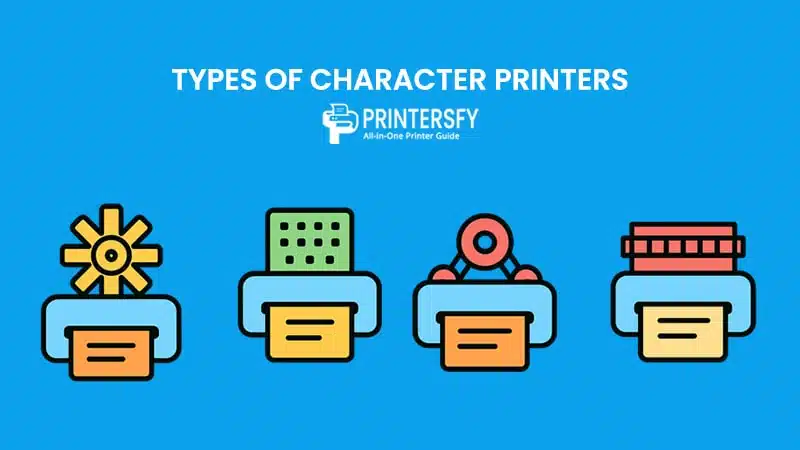
Character printers come in several distinct forms, each engineered for a different balance of speed, print clarity, durability, and workload. While they all fall under the same mechanical, impact-based category, the way they generate characters varies significantly.
These differences shaped where each type was used—ranging from office word processing to massive enterprise print jobs in data centers. The Character Printer family includes daisy wheel models, dot matrix units, chain printers, and band printers, each with its own strengths and limitations.
| Feature / Type | Daisy Wheel Printer | Dot Matrix Printer | Chain Printer | Band Printer |
|---|---|---|---|---|
| Print Method | Impact with metal characters on wheel | Impact with pin matrix | High-speed line impact with rotating metal chain | High-speed line impact with flexible metal band |
| Print Quality | Very high (letter-quality) | Medium (dot-based characters) | Medium | Medium |
| Graphics Support | None (text only) | Basic graphics (patterns, charts, simple shapes) | None | None |
| Speed | Slow (character-by-character) | Moderate to fast | Very fast (hundreds to thousands of LPM) | Very fast (similar to chain) |
| Noise Level | High | Moderate | Very high | High |
| Character Flexibility | Limited (wheel swap needed) | Good (pin patterns allow custom shapes) | Fixed to characters on chain | Fixed to characters on band |
| Durability | Very durable | Durable; pins wear slowly | Extremely durable | Extremely durable |
| Use Cases | Legal documents, formal letters | Invoices, reports, multi-part forms, mixed text+graphics | Enterprise reports, mainframe output | Bank reports, financial logs, enterprise batch printing |
| Multi-Part Forms | Good | Excellent | Excellent | Excellent |
| Cost to Operate | Moderate | Low | High | High |
| Typical Environment | Office word processing | Business & general office | Data centers, mainframes | Corporate enterprise printing |
| Strengths | Best text clarity | Flexible output; cheap | Highest throughput | Fast and stable operation |
| Weaknesses | Slow, no graphics | Lower text quality | Noisy, limited fonts | Noisy, limited fonts |
Daisy Wheel Printer
One of the most recognizable members of the Character Printer family is the daisy wheel printer. This model produces letter-quality text using a wheel with characters embossed onto thin “petals.” When printing, the wheel spins to position the correct character, and a hammer strikes it against the ribbon to create a clean imprint on the page.
Because each letter is a solid metal shape, daisy wheel output is sharp, consistent, and comparable to a high-grade typewriter.
However, this technology has a clear limitation: it can only print the characters physically present on the wheel. That means no graphics, no diagrams, and no variable fonts unless the user swaps the entire wheel.
Its precision also comes at the cost of speed—printing character by character makes it slower than most other impact printers. Still, during its peak, businesses valued it for producing polished, formal text that other machines couldn’t match.
Dot Matrix Printer
The dot matrix printer is the most flexible and widely recognized type of Character Printer. Instead of using fully formed metal symbols, it uses a grid of pins in the print head. These pins strike the ribbon in patterns to form characters, similar to drawing with a tiny dot-based stencil.
This design gives dot matrix printers a major advantage: they can print basic graphics, simple charts, forms, and even custom symbols, something daisy wheel machines can’t do.
Another benefit comes from durability and ease of maintenance. The pins and ribbons are designed for long-term use, and replacements are inexpensive. Businesses embraced dot matrix printing in environments where speed, flexibility, and cost mattered more than perfect text quality.
Multi-part forms were another strong point—impact from the pins could carry through multiple carbon layers, making them ideal for invoices, shipping documents, and transactional paperwork.
The trade-off is that the print quality is lower. Because characters are formed from a matrix of dots rather than solid shapes, the output looks rougher, especially at small sizes or on low-quality paper. But for businesses needing versatility, dot matrix printers delivered the best balance between capability and cost.
Chain Printer
Chain printers belong to the high-speed end of the Character Printer spectrum. Instead of printing one character at a time, they use a rotating metal chain made of repeating character sets.
As the chain moves rapidly across the print line, a hammer bank strikes the correct character exactly when it passes the print position. This allows the printer to output entire lines in fractions of a second.
Because of their power and speed, chain printers were commonly used in mainframe environments where enormous volumes of data needed to be printed—financial statements, transaction reports, inventory logs, and other bulk documentation.
A typical chain printer could produce hundreds or thousands of lines per minute, making it one of the fastest impact printers ever built.
However, the design comes with noise, vibration, and limited flexibility. The characters available on the chain are fixed, and changing fonts or symbol sets requires swapping the chain itself—something few organizations bothered to do. Still, as classic chain printer and line printer units, they were unmatched for large-scale enterprise work.
Band Printer
Band printers operate similarly to chain printers but use a thin, flexible metal band instead of a heavy rotating chain. The band carries embossed characters that move continuously across the print line.
When the correct character reaches the print position, the hammer strikes, transferring ink onto the paper. This design makes band printers slightly quieter and more stable than chain models while maintaining impressive speeds.
This type of Character Printer found its place in enterprise computing environments where high throughput and reliability were essential.
Large corporate data centers, bank back-offices, and industrial controllers often relied on band printers for generating logs, reports, and multi-line outputs. Their mix of speed and durability gave them a long operational lifespan even as more modern printing systems emerged.
Although they face the same limitations as chain printers—fixed character sets, no graphics, and considerable noise—their consistent performance made them a trusted tool for organizations with heavy printing workloads. As a classic example of a band printer design, they represent the peak of mechanical line-printing efficiency.
Characteristics of Character Printers
The Character Printer family is known for its rugged design, predictable output, and mechanical reliability. Unlike modern printers that rely heavily on electronics and complex imaging systems, character printers use physical motion to create text.
These machines were built for environments where durability and consistency mattered more than aesthetics. Their characteristics can be grouped into physical traits, printing behavior, and the inherent limitations that shaped their long-term usage.
Physical Characteristics
The physical design of a Character Printer reflects its purpose: stable operation, long life, and dependable performance under continuous workloads. These printers often look industrial, not stylish, because nearly every component is engineered around mechanical precision and durability.
Print head
The print head is the centerpiece of the machine. Depending on the printer type, it may contain fixed metal characters (daisy wheel), a grid of pins (dot matrix), or interface with a rotating chain or band that carries embossed symbols. It is built from metal parts designed to withstand repeated impact, sometimes tens of millions of strikes over the lifespan of the printer. Its durability directly influences print clarity and long-term reliability.
Ribbon mechanism
Character printers use an inked fabric ribbon stretched across the print line. As the print head strikes the ribbon, ink transfers to the page. The ribbon mechanism includes tension rollers, a feed system, and guides that keep the fabric aligned.
Because the printing method is impact-based, the ribbon must be durable enough to handle thousands of strikes per page while still maintaining consistent ink distribution. Many ribbons in this category last significantly longer than cartridges in modern printers.
Mechanical housing
Most character printers are built with heavy frames and solid enclosures. The mechanical housing absorbs vibration created during impact and ensures stability, especially for line printers where high-speed movement generates strong mechanical forces.
This sturdy construction makes them suitable for factory floors, data centers, and high-volume print rooms where lighter devices might fail.
Printing Characteristics
How a character printer behaves during operation is defined by its speed, noise output, and print quality. These factors determine where the printer is best suited and what kind of documents it handles well.
Speed (cps vs lps)
Character printers measure speed in two ways: characters per second (cps) for serial printers and lines per second (lps) for line printers. Serial printers like daisy wheel and dot matrix units are slower, producing between 10–75 cps or sometimes up to 200 cps for high-end dot matrix models.
Line printers, however, operate at an entirely different scale—printing full lines at once, often reaching 50–100 lines per second. This made them ideal for generating continuous reports or large data dumps.
Noise levels
Noise is a defining trait of character printers. Because each printed symbol involves a physical strike, the operation can be loud, rhythmic, and sometimes harsh.
Daisy wheel printers produce a sharp tapping, dot matrix units emit a buzzing or rattling sound, and chain or band printers are notoriously loud due to rapid, heavy mechanical movement. For many offices, noise was simply part of working with impact printers, but it also meant these devices were often placed in separate rooms.
Print quality variance
Print quality varies widely depending on the printer type. Daisy wheel models offer the best text appearance, producing clean, typewriter-level characters. Dot matrix printers fall in the middle—they create recognizable but less refined characters formed from dot patterns.
Line printers prioritize speed over quality, delivering functional but less polished output. This variance is one reason why the Character Printer category served such a broad range of environments, from formal document production to industrial logging.
Limitations
Despite their strengths, character printers come with built-in limitations that stem from their mechanical design and printing method.
Mechanical wear
Because printing depends on physical impact, every component gradually wears down. Hammers lose responsiveness, ribbons thin out, pins bend, wheels misalign, and motors require recalibration. In high-volume settings, maintenance schedules were essential. Regular servicing extended the printer’s life, but wear and tear were unavoidable in systems with constant mechanical force.
Limited fonts/graphics
Character printers are fundamentally limited in the range of characters they can produce. Daisy wheel, chain, and band printers rely on fixed sets of embossed symbols, meaning fonts are restricted to whatever the hardware physically contains.
Even dot matrix printers, which offer more flexibility, cannot create high-resolution graphics due to their coarse pin grid. As business needs evolved toward visual layouts, logos, and graphical elements, this limitation became a major reason organizations moved to non-impact printers.
Examples of Character Printers
Different machines within the Character Printer category became well-known not only for their technology, but also for the roles they played in business computing, early office automation, and enterprise data processing.
Some stood out because of their precision, others because of their speed, and a few simply because they were built like tanks and could run nonstop for years. Below are some of the most influential historical models, followed by a look at where character printers still appear today.
Popular Historical Models
Several machines shaped how organizations printed text during the early decades of computing. Each represented a different style of impact printing, and together they illustrate the range of technologies that made character printers essential tools of their era.
These examples also show how the Character Printer evolved as computing needs expanded across offices, factories, banks, and mainframe systems.
Diablo 630 (daisy wheel)
The Diablo 630 became one of the landmark daisy wheel printers of the late 1970s and early 1980s. Known for its exceptionally sharp text, it delivered true letter-quality output that businesses relied on for contracts, legal communication, and other formal documents.
Its modular wheel system allowed typeface changes—primitive by today’s standards but groundbreaking at the time. The model’s combination of precision and reliability helped cement daisy wheel printing as a trusted choice for office word processing.
Epson FX-series (dot matrix)
Epson’s FX-series became the face of dot matrix printing for small and medium-sized businesses. The machines used pin-based impact to form characters and simple graphics, making them more flexible than fixed-character systems.
They were popular for invoices, transactional forms, and multi-copy documents, especially in accounting and retail environments. Their durability, relatively low price, and compatibility with early PCs helped position the FX-series as one of the most recognizable dot matrix Character Printer lines ever sold.
IBM 1403 (chain printer)
The IBM 1403 is legendary in the world of mainframe computing. Introduced in the early 1960s, it used a rapidly moving chain of characters to print entire lines at remarkable speed.
Known for its thunderous noise and massive throughput, it became the backbone of enterprise reporting for banks, insurance companies, and government agencies. The 1403 demonstrated how line-printing technology could scale to industrial-level workloads and established IBM as a leader in high-volume character printing.
Modern Niche Usage
Although they no longer dominate offices, character printers still fill practical gaps where durability, multi-copy output, or permanent impact marks are required.
The machines survive not because of nostalgia, but because certain industries demand features that modern inkjet or laser printers simply don’t deliver.
Finance & multi-part forms
Banks, accounting departments, and logistics companies still use dot matrix and similar machines for multi-part forms. The impact of the pins can carry through multiple layers of carbon or NCR paper, creating several copies in a single pass.
This makes character printers valuable for receipts, transaction slips, delivery forms, and records that need to be printed and stored immediately.
Industrial environments
Factories, warehouses, and equipment-monitoring stations still rely on character printers for printing system logs, machine readouts, audit trails, and environmental data. Many industrial controllers are built around legacy interfaces, and impact printers remain the simplest and most fail-safe output devices.
Their resistance to heat, dust, and vibration gives them an advantage over delicate modern printers. In these contexts, the machines persist as part of legacy printing technology that still performs reliably under harsh conditions.
These examples show that while the Character Printer may no longer be mainstream, its influence and utility remain alive in specialized industries where impact printing still matters.
Advantages of Character Printers

While modern printing technologies have surpassed impact devices in speed and visual quality, the Character Printer still carries several advantages that kept it relevant for decades.
These strengths aren’t just historical—they remain important in specific industries that require durability, multi-copy capability, and dependable long-term operation. The following advantages highlight why character printers were so widely used and why some organizations still rely on them today.
Durable & Mechanical Reliability
One of the biggest advantages of the Character Printer is its mechanical endurance. These machines were built with metal frames, solid internal components, and impact mechanisms designed to endure millions of strikes.
Unlike inkjet printers, which rely on sensitive nozzles, or laser printers, which depend on complex optical assemblies, character printers function using straightforward mechanical parts that are easy to understand and resilient under stress.
This rugged design makes them suitable for environments where dust, heat, vibration, or humidity may interfere with the operation of more delicate printers.
Factories, warehouses, and server rooms often used character printers not because they lacked alternatives, but because these machines could run for years with minimal intervention. Their predictable performance, even under heavy workloads, helped them earn a reputation as machines that “just don’t quit.”
Multi-Part Form Capability
Perhaps the most important advantage—and the main reason character printers are still used today—is their ability to produce multi-part forms.
The physical impact generated by the print head allows the printer to transfer characters through several layers of carbon or NCR paper at once. This means one pass of printing can create two, three, or even four copies instantly, without needing special settings or additional printing cycles.
This capability is indispensable in industries that rely on immediate, tamper-resistant documentation. Delivery companies need multi-copy invoices, retail stores need receipts that include both customer and merchant copies, and financial operations benefit from pressure-based duplicate records.
Because the impact imprint is strong and consistent, the Character Printer excels at tasks where digital methods cannot reliably produce layered copies. In many cases, these industries still use character printers today because carbonless forms remain part of their workflow and would require expensive process changes to replace.
Cost-Effective Operation
Character printers are extremely cost-efficient to operate. Their ribbons last a long time, mechanical parts rarely fail unless exposed to extreme wear, and the machines themselves have long life spans. Compared to toner or ink cartridges—which dry out, clog, or require frequent replacement—impact ribbons offer a consistent yield with very low operating costs.
For organizations that print large volumes of text-only documents, this cost efficiency becomes a significant advantage.
Even though modern printers are faster, a character-based system can remain cheaper to maintain over the long term. In environments where budget stability matters more than print resolution, the Character Printer delivers reliable output at minimal ongoing expense.
Disadvantages of Character Printers
Despite their strengths, character printers also come with drawbacks that limited their usefulness as office needs evolved. These disadvantages eventually contributed to the rise of inkjet and laser technologies, which better matched modern expectations for speed, visuals, and user convenience.
Noise and Vibration
By design, impact printing is loud. Each character requires a physical strike, and during long print jobs the repetitive tapping, buzzing, or banging can become disruptive.
Daisy wheel models produce sharp impacts, dot matrix printers generate rapid rattling sounds, and chain or band printers are notoriously thunderous due to their high-speed mechanics.
For many workplaces, this noise made character printers impractical, especially as offices moved toward quieter environments. Even with enclosures or sound-dampening cabinets, the vibration and mechanical clatter were difficult to eliminate. This disadvantage alone pushed many businesses to switch to quieter, non-impact alternatives.
Limited Print Resolution
Another major drawback is the limited resolution of character-based output. Since printing depends on fixed metal shapes or pin patterns, detail is inherently restricted.
Daisy wheel printers offer crisp text but no graphics. Dot matrix printers can print basic images, but the dot grid limits clarity and detail. Chain and band printers, focused on speed, sacrifice both text refinement and flexibility.
As documents increasingly required logos, charts, and graphic elements, the Character Printer could not keep up. The need for sharp visuals and varied formatting made non-impact printers far more appealing for modern business communication.
Maintenance & Mechanical Wear
Character printers rely on moving parts that undergo constant stress. Hammers wear down, pins get bent, wheels lose alignment, bands stretch, and chains require lubrication. While the machines are durable, they are not maintenance-free. Over time, print quality can degrade unless components are adjusted or replaced.
In high-volume environments, scheduled maintenance was common, adding labor and downtime costs. Because everything depends on physical timing and impact force, even slight wear can affect alignment or character clarity.
These limitations made upkeep more demanding compared to modern printers with fewer mechanical components. As office workloads grew and expectations shifted toward minimal-maintenance devices, the intensive mechanical nature of character printers became a clear disadvantage.
Uses of Character Printers

Although modern printing technologies have taken over most office environments, the Character Printer still holds practical value in several fields. Its impact-based printing, durability, and ability to generate clear, tamper-resistant text give it a role that digital printers cannot easily replace.
These machines continue to serve industries where reliability, multi-part forms, and physical impressions on paper are essential. Below are the primary sectors where character printers historically thrived—and where many of them still operate today.
Business & Office Uses
Before inkjets and lasers became affordable, many offices relied on the Character Printer for day-to-day documentation. Even today, certain workflows still benefit from its consistency and the way it handles multi-copy printing.
Legal letters
Formal letters, contracts, and legal correspondence were often produced using character printers because the output resembles typewritten text—clean, sharp, and uniform. The mechanical impact leaves impressions that are harder to alter than toner or inkjet prints. This made character-based output particularly suitable for agreements, compliance paperwork, or documents that required a “permanent” look.
Multi-copy invoices
Multi-copy forms were one of the strongest use cases for character printers. Businesses that needed multiple layers of carbon or NCR paper—such as wholesalers, freight forwarders, repair shops, and distributors—used these printers to produce instant duplicates. One strike produced two or three copies at once, each with consistent readability. For many companies, migrating away from multi-part invoices would have required redesigning their entire workflow, so character printers remained the practical choice.
Serial reports
Before digital dashboards existed, companies relied on printed serial reports to track inventory, sales logs, and production summaries. Character printers excelled at generating long, continuous reports without overheating or jamming. Their durability made them suitable for daily or hourly reporting cycles where downtime wasn’t an option.
Government & Administrative Institutions
Government offices were among the biggest adopters of character printers and, in some cases, still are. Large administrative systems often require tamper-resistant, long-lasting printed documents—something the Character Printer delivers exceptionally well.
Departments responsible for licensing, civil records, taxation, and regulatory paperwork often used impact printers because of their consistency and physical print impressions. The prints hold up well in archives and remain readable for decades, even in suboptimal storage conditions.
Another advantage is traceability. Impact-printed text is difficult to modify without leaving obvious signs, making it suitable for forms involving approvals, stamps, or verification processes. Court offices, public registries, and enforcement agencies historically depended on character printers for precisely this reason. Even as forms have been digitized, some administrative workflows still require printed copies with a physical impression on the page.
Industrial & Logistical Operations
Industrial environments are where character printers have shown some of their strongest long-term staying power. Factories, warehouses, and processing facilities often use hardware that operates continuously, sometimes under heat, dust, or vibration. Modern printers struggle under these conditions, but character printers handle them with ease.
Warehousing
In warehouse operations, character printers were used for bin labels, pick lists, receiving logs, loading reports, and continuous serial output. Impact-based printing creates text that stays readable even on rougher paper or forms exposed to handling. Their reliability meant they could run nonstop alongside other industrial equipment without constant calibration or cleaning.
Machine interfaces
Many industrial machines—especially legacy systems—still output data through parallel or serial interfaces designed decades ago. Because of this, character printers remain compatible with older control units, monitoring systems, and diagnostic equipment. They can print log entries, temperature readings, machine status updates, and audit trails directly from manufacturing hardware without needing software conversion layers.
In some industries, the physical imprint left on the page supports verification printing. For example, audit logs in regulated environments must remain unalterable, and impact printing ensures that attempts to modify records are immediately noticeable. This makes character printers valuable tools for compliance, monitoring, and transparent record keeping.
Difference Between Character Printer and Other Impact Printers
Although all impact printers share the same principle—printing by physically striking an inked ribbon—each type works differently and serves a different purpose. The Character Printer is a broader category that includes several mechanisms, but when compared directly with dot matrix printers, daisy wheel printers, and line printers, the distinctions become much clearer.
Character Printers focus on producing text using mechanical selection of characters, such as pins, embossed shapes, wheels, chains, or bands. Their strength lies in durability and multi-copy printing, but each subtype offers a different balance of precision, speed, and flexibility.
Dot Matrix Printers use a grid of pins to form characters through patterns of dots. They can print simple graphics and support continuous forms, making them popular in retail, logistics, and accounting. Their biggest advantage is flexibility, but they sacrifice sharpness.
Daisy Wheel Printers, on the other hand, produce the best text quality within impact technology. They create characters using a wheel with pre-formed metal shapes, giving crisp, typewriter-like output. However, they cannot print graphics at all and are slower than other impact printers.
Line Printers such as chain or band printers operate in a completely different league. Instead of printing one character at a time, they print entire lines in rapid succession. They were designed for enterprise computing, where thousands of lines of data needed to be printed quickly. The trade-off: lower print quality and extremely high noise levels.
Understanding these differences helps clarify why businesses chose specific impact printers depending on whether they needed speed, clarity, flexibility, or industrial endurance.
Comparison Character Printer vs Other Impact Printers
| Type of Printer | Print Method | Print Quality | Speed | Graphics Support | Best Use Case |
|---|---|---|---|---|---|
| Character Printer | Mechanical impact (various mechanisms) | Medium (varies by type) | Slow to very fast | Limited/None | Multi-part forms, industrial tasks |
| Dot Matrix | Pins striking ribbon to form dots | Medium | Moderate to fast | Basic graphics | Retail, invoices, logistics |
| Daisy Wheel | Metal characters on rotating wheel | Very high for text | Slow | None | Legal documents, formal letters |
| Line Printer | High-speed chain/band print line | Medium/Low | Extremely fast (LPM scale) | None | Mainframe reports, enterprise output |
Conclusion
The Character Printer may no longer dominate modern offices, but its influence on the evolution of business computing is undeniable. Built around mechanical precision and impact-based printing, these machines delivered durability, consistency, and the unique ability to produce multi-part forms—capabilities that many contemporary printers still cannot fully replace.
From daisy wheel models known for crisp, letter-quality text to dot matrix units valued for flexibility, and high-speed line printers used in enterprise systems, character-based devices shaped workflows across industries for decades.
Even today, they continue to serve niche roles in finance, logistics, government, and industrial operations where reliability and tamper-resistant output matter more than graphics or high resolution. As printing technology advances, the character printer stands as a reminder of a time when engineering, timing, and physical impact were at the heart of document production.
Its legacy lives on not only in specialized environments, but also in the fundamental principles of durability and precision still valued in modern hardware design.
FAQs About Character Printer
What is a character printer?
A character printer is an impact-based printer that produces text by striking an inked ribbon against paper, printing one character at a time. Different mechanisms—pins, wheels, chains, or bands—are used depending on the printer type.
Is a daisy wheel a character printer?
Yes. A daisy wheel printer is a type of character printer. It uses a rotating wheel with embossed characters, striking each symbol onto the page to create sharp, typewriter-quality text.
Which printer prints character by character?
Character printers such as daisy wheel and dot matrix models print character by character. Serial impact printers operate this way, moving horizontally across the page and printing each character in sequence.
What is another name for a character printer?
Character printers are often referred to as impact printers, especially when distinguishing them from non-impact technologies like inkjet and laser. They may also be called serial printers or line printers, depending on their mechanism.
Is dot matrix a character printer?
Yes. A dot matrix printer is a type of character printer that forms characters from patterns of small metal pins. It can also print simple graphics, making it more flexible than fixed-character systems like daisy wheel printers.
