
When multiple offices, campuses, or institutions within a city need to stay connected at high speeds, a typical local area network just won’t do. This is where a Metropolitan Area Network (MAN) becomes essential—bridging the gap between the limited reach of LANs and the expansive infrastructure of WANs.
Often built using high-speed fiber optic cables, MANs are designed to connect users, systems, and data centers across an entire metropolitan region. From enabling real-time communication between hospitals and government buildings to powering city-wide Wi-Fi and surveillance systems, MANs play a critical role in urban digital infrastructure.
Understanding how a Metropolitan Area Network works, what makes it different from other types of networks, and where it’s applied in the real world is key to appreciating its value—especially as cities grow smarter and more connected every day.
What Is a Metropolitan Area Network (MAN)?
Definition and Core Characteristics
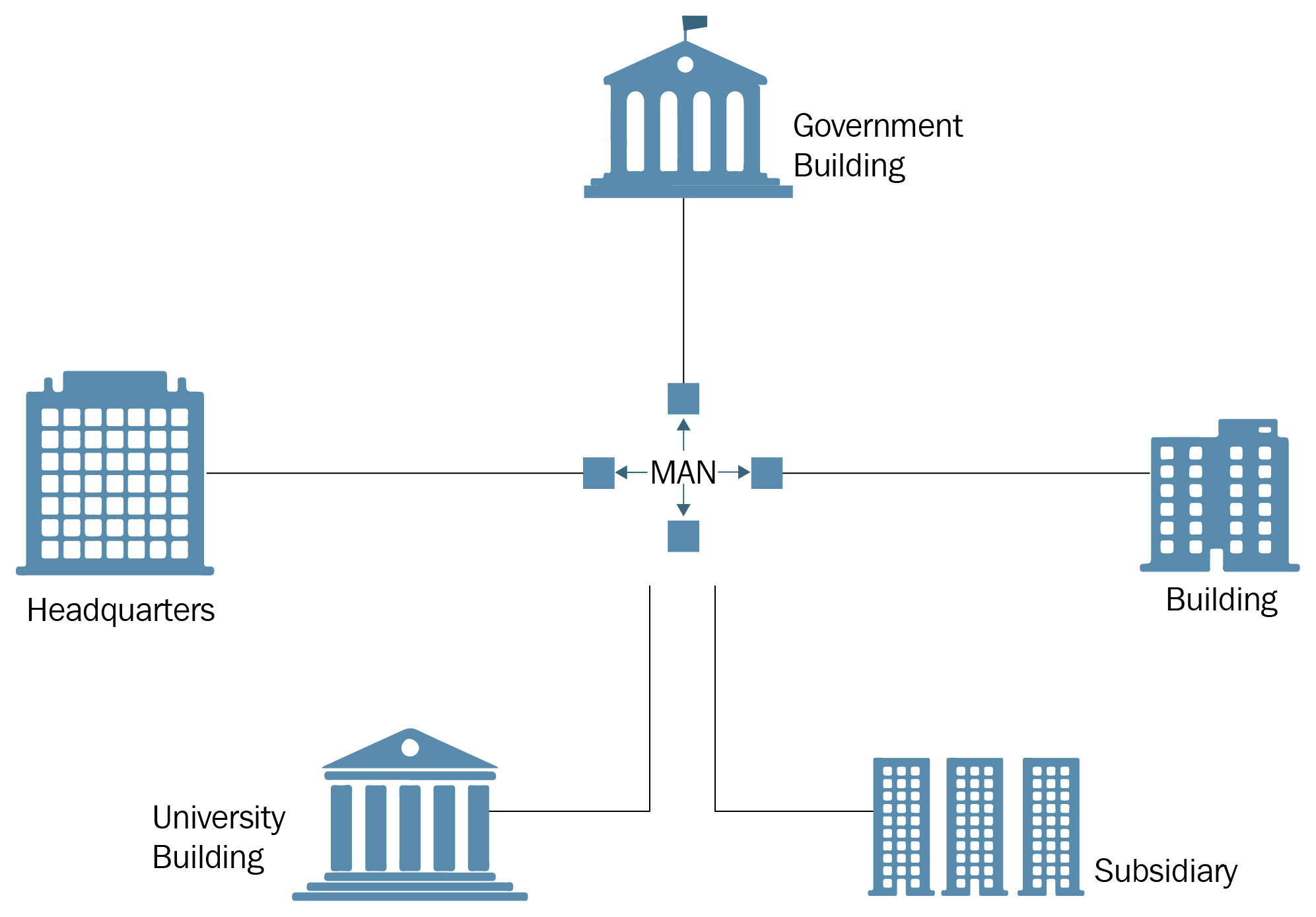
A Metropolitan Area Network (MAN) is a type of computer network that spans a city, a large campus, or a specific urban area—connecting multiple buildings, offices, or facilities within a geographical region larger than a LAN but smaller than a WAN. It’s commonly deployed by governments, educational institutions, or enterprises that need consistent high-speed connectivity across locations that are physically separated but relatively close.
Unlike a Local Area Network (LAN), which is typically confined to a single building or site, a MAN is optimized for distance—ranging from a few kilometers to up to 50 kilometers. It usually relies on high-bandwidth media like fiber optics and is structured to provide low latency and high reliability for applications such as video conferencing, shared data centers, and smart city infrastructure.
Most Metropolitan Area Networks are owned either by a single organization or operated as public utilities, depending on the size and purpose. The underlying infrastructure may use dedicated circuits, leased lines, or even wireless technologies like microwave or 5G in some cases.
Key Differences Between LAN, MAN, and WAN
To clearly understand where MAN fits into the broader network landscape, it helps to compare it directly with the two more familiar types: LAN and WAN.
| Feature | LAN (Local Area Network) | MAN (Metropolitan Area Network) | WAN (Wide Area Network) |
|---|---|---|---|
| Geographic Coverage | Small – single building | Medium – city or metro area | Large – country or global |
| Ownership & Control | Private – single organization | Often public/private hybrid | Typically multiple providers |
| Speed & Bandwidth | High | Medium to High | Variable – depends on setup |
| Cost | Low | Moderate | High |
| Typical Technologies | Ethernet, Wi-Fi | Fiber optics, Microwave | MPLS, VPN, Satellite |
| Use Cases | Office, home, campus | Government, city services, ISPs | Global enterprises, ISPs |
While LANs are ideal for small-scale environments like homes or offices, and WANs serve multi-national organizations, MANs are purpose-built for scenarios in between—such as linking campuses across a city or providing internet backbones for urban areas. They strike a balance between scale, speed, and complexity.
How a MAN Network Works

MAN Architecture and Components
The architecture of a Metropolitan Area Network is designed to support high-speed, high-capacity communication across a city or urban region. At its core, a Metropolitan Area Network uses a central backbone—often made of fiber optic cables—that interconnects various local networks (LANs) in different locations. These connections may span between corporate buildings, university campuses, hospitals, or government facilities within the metropolitan area.
A typical MAN architecture includes core routers or switches that manage traffic between locations, aggregation points that consolidate multiple connections, and edge devices that link end-user networks to the MAN backbone. Depending on its purpose, a MAN may also include redundant paths, load balancing systems, and centralized network management software to ensure consistent service and fast data delivery.
Unlike LANs that are generally flat in structure, a MAN must accommodate larger traffic loads and more complex routing logic. This often requires integrating both Layer 2 (data link layer) and Layer 3 (network layer) devices for efficient data forwarding, segmentation, and routing within the network.
Transmission Technologies Used in MAN
A Metropolitan Area Network can be built using a variety of transmission technologies depending on budget, scale, and performance goals. One of the most common technologies is fiber optic cabling, which provides extremely high bandwidth and low latency—essential for services like video conferencing, VoIP, and cloud computing across multiple buildings or districts.
Another widely used method is Microwave Radio Transmission, often employed where physical cabling is not feasible. This wireless technology allows for point-to-point communication using high-frequency radio signals, and it’s commonly seen in city-wide connectivity setups or emergency communication networks.
Other transmission options include Synchronous Optical Networking (SONET) and Metro Ethernet. Metro Ethernet, in particular, is popular for its scalability and ease of integration with existing LAN infrastructure, allowing businesses and public services to extend their internal networks across the city seamlessly.
In many cities, MANs also leverage 5G or WiMAX to supplement fixed infrastructure with wireless coverage, especially in areas with high mobility demands or where rapid deployment is needed.
Benefits of a Metropolitan Area Network (MAN)

A Metropolitan Area Network (MAN) offers numerous advantages for organizations and cities that require reliable, high-speed communication across a large geographic area. By design, MANs provide a scalable and efficient solution to connect multiple sites—whether they’re campuses, offices, or municipal services—under a unified infrastructure.
One of the most significant benefits is cost-efficiency at scale. Instead of relying on multiple separate internet connections or private WAN links between facilities, organizations can centralize their connectivity through a shared Metropolitan Area Network backbone. This reduces operational expenses, especially for large institutions like universities or hospitals that operate in multiple buildings or districts.
MANs also enhance network performance and bandwidth availability, allowing for high-speed data transfer between sites without the bottlenecks typically seen in wider networks like WANs. Because MANs are often built on fiber optic or dedicated microwave infrastructure, they offer low latency and high reliability—making them ideal for time-sensitive applications like real-time monitoring, VoIP, or cloud-based collaboration platforms.
Another key advantage is centralized resource management. IT teams can manage and secure the network from a single location, apply uniform access policies, and monitor traffic patterns across the entire metropolitan network. This improves both security and administrative control.
Summary Table: Key Benefits of MAN
| Benefit | Description |
|---|---|
| Cost Efficiency | Shared infrastructure lowers long-term costs for multi-site organizations. |
| High Performance | Supports high bandwidth and low latency across connected locations. |
| Centralized Management | Simplifies network monitoring and policy enforcement. |
| Scalability | Easy to expand to new buildings or areas within the metro region. |
| Reliability | Redundant architecture ensures stable and continuous service. |
Real-World Applications of MAN Networks
The practical impact of Metropolitan Area Networks is most visible in environments where fast, secure, and consistent communication is critical across a city or region. MANs enable public and private institutions to streamline operations, improve service delivery, and reduce infrastructure redundancy through shared network resources.
Public Sector
In the public sector, many city governments use MANs to connect their administrative buildings, police stations, fire departments, and transportation control centers. This allows for centralized communication, faster response times in emergencies, and unified access to databases, surveillance feeds, and dispatch systems. For example, a municipal Metropolitan Area Network can link traffic control sensors to a centralized command center, enabling real-time adjustments to traffic lights and congestion management.
Education Sector
In the education sector, universities and colleges with multiple campuses across a city often deploy MANs to create a seamless academic network. Faculty and students can access shared research databases, campus-wide learning management systems, and centralized email or file storage services—regardless of which building they’re in. The high-speed connection also supports video conferencing for remote lectures or inter-campus collaboration.
Healthcare Systems
Healthcare systems also benefit from MAN deployments. Hospitals, clinics, and research labs within a city can share large medical files like MRI scans or patient records in real time. A Metropolitan Area Network also ensures continuous access to cloud-based healthcare applications, telemedicine services, and internal VoIP systems that keep teams coordinated across departments and locations.
Private Sector
In the private sector, businesses with multiple office buildings—such as banks, logistics firms, or tech companies—use MANs to ensure reliable data exchange, high-speed internet access, and secure communication between headquarters and branch locations. A well-structured MAN reduces latency in enterprise applications, accelerates file synchronization, and centralizes IT control, which is crucial for compliance and performance monitoring.
Comparison: MAN vs LAN, WAN, and PAN

To better understand where a Metropolitan Area Network (MAN) fits within the broader landscape of networking, it’s essential to compare it with other common types: LAN (Local Area Network), WAN (Wide Area Network), and PAN (Personal Area Network). Each serves a distinct scale and purpose, with MANs sitting in the middle—bridging the gap between small-scale local networks and large-scale global connections.
While a LAN typically operates within a single building (like an office or school), a MAN extends across an entire city, connecting multiple LANs together. A WAN, on the other hand, spans much greater distances—regionally, nationally, or even globally—linking data centers or branch offices across continents. Meanwhile, a PAN is the smallest of all, designed for personal devices like smartphones, tablets, and wearables, usually within a few meters of range.
Below is a summary table to illustrate the differences between these four network types:
Table: Comparison of PAN, LAN, MAN, and WAN
| Network Type | Coverage Area | Typical Use Case | Speed | Ownership | Example |
|---|---|---|---|---|---|
| Personal Area Network (PAN) | Within a few meters | Personal device communication | Low | Individual | Bluetooth between phone & headset |
| Local Area Network (LAN) | Single building or campus | Internal office or home network | High | Private organization | Wi-Fi in an office or school |
| Metropolitan Area Network (MAN) | City or metropolitan area | Linking campuses, offices, or services | Very High | Often shared or public-private | City-wide university network |
| Wide Area Network (WAN) | Country or global scale | Connecting global branches or data centers | Varies (can be high) | Private or consortium | Internet, corporate WAN |
This comparison helps clarify the role of MANs as a bridge between local accessibility and wide-scale connectivity—offering high-speed, cost-effective solutions where LANs fall short and WANs may be excessive or costly.
Conclusion
Metropolitan Area Networks (MANs) play a pivotal role in modern connectivity by linking multiple local networks across a city or urban area. Their ability to offer high-speed communication, cost-sharing infrastructure, and improved data access makes them ideal for governments, universities, healthcare systems, and enterprises alike.
Unlike LANs, which are confined to a building, or WANs that span vast distances, MANs provide the perfect balance of coverage and efficiency—especially in environments that demand seamless data exchange across multiple locations. As smart cities, digital governance, and cloud-based services continue to evolve, the importance of reliable MAN infrastructure will only grow.
Understanding how MANs work, where they are used, and how they compare to other network types is essential for anyone involved in network planning, IT strategy, or digital transformation at the metropolitan level.
FAQ: Metropolitan Area Network (MAN)
What is the main purpose of a Metropolitan Area Network (MAN)?
A MAN connects multiple LANs across a city or metropolitan region to enable high-speed communication between different locations such as campuses, offices, or government facilities.
How does a MAN differ from a WAN and a LAN?
A LAN is limited to a small area (like a home or office), a MAN spans an entire city, and a WAN covers broad geographic regions or countries. MANs offer a middle ground in terms of scale and performance.
What are some real-world examples of MANs?
Examples include city-wide university networks, municipal surveillance systems, inter-hospital data sharing within urban areas, and government infrastructure networks connecting administrative buildings.
Is a Metropolitan Area Network owned by a single organization?
Not always. Some MANs are privately owned, but many are built and maintained by telecom providers or through public-private partnerships, depending on the purpose and scope.
What technologies are used in MAN networks?
MANs commonly use fiber-optic cables, Ethernet, MPLS (Multiprotocol Label Switching), or wireless technologies like microwave and WiMAX to achieve fast and reliable connectivity.
