

Installing an HP printer on macOS often looks finished long before it actually is. The printer appears in the system list, the status shows “Ready,” and everything seems fine at a glance. The first print job usually tells a different story when users try to Install HP Printer Drivers on macOS expecting the same behavior they are used to on Windows.
Paper sizes are missing. Duplex options are unavailable. Color controls never appear. These problems are not random. They reflect how macOS assigns drivers and how quickly the system settles on a default match.
macOS handles printer support differently. Instead of relying on visible driver packages, it leans on automatic matching and built-in compatibility layers. For many HP models, that approach is enough to get a document out of the printer without errors.
The connection works. The job completes. The system moves on. What it does not guarantee is full feature access. In many cases, hp printer drivers for mac are already active, but only at a basic level.
When mac hp printer drivers are selected this way, reinstalling the printer or switching between USB and wireless connections often leads back to the same limitations. The printer changes state, but the driver choice does not.
How macOS Handles Printer Drivers Behind the Scenes
macOS treats printer drivers as part of the operating system rather than as independent printer software. When a printer connects—either through USB or over a local network—the system immediately attempts to identify it using existing frameworks.
This is why users can often Install HP Printer Drivers on macOS without seeing a single installer window. The process happens silently, based on what macOS already has available.
AirPrint plays a central role in this behavior. If an HP printer supports it, macOS assigns a native profile and proceeds without hesitation. Even printers without full AirPrint support are often matched with built-in alternatives from Apple’s driver library.
These hp printer drivers mac are designed for stability and broad compatibility, not for exposing every hardware feature. As a result, setup completes quickly, but advanced controls may never appear.
This design choice also explains why clicking “Add Printer” rarely triggers additional downloads. macOS assumes the selected driver is sufficient unless something actively fails.
From the system’s perspective, printing that completes successfully is preferable to loading a specialized package that might introduce compatibility risks. That assumption becomes visible after users Install HP Printer Drivers on macOS and discover that certain HP-specific functions are unavailable.
For HP printers, this behavior can be more noticeable. Some models rely on older hp printer drivers mac os x packages that Apple no longer updates, while others are optimized for streamlined workflows with fewer configurable options.
mac printer drivers hp selected by macOS may prioritize reliability over flexibility, which explains why reinstalling or reconnecting the printer often leads back to the same result—even after another attempt to Install HP Printer Drivers on macOS.
How to Install HP Printer Drivers on macOS
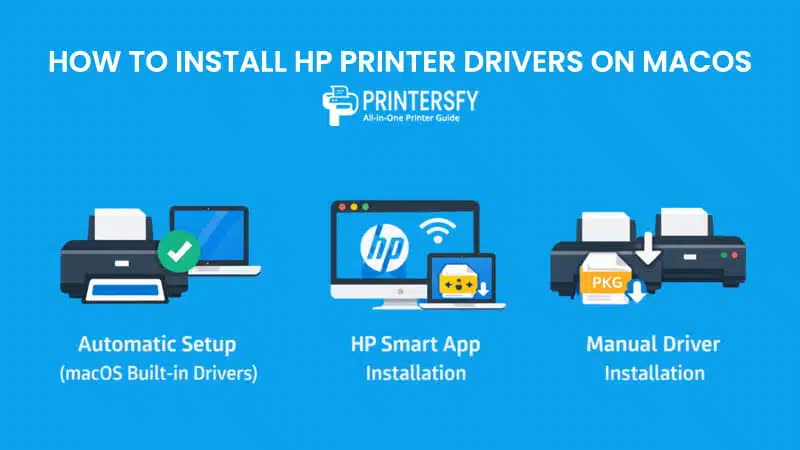
Installing an HP printer on macOS does not always mean choosing a single method and following it blindly. The system behaves differently depending on the printer model, the connection type, and how macOS decides to assign a driver. This is why attempts to Install HP Printer Drivers on macOS can lead to different results even when the steps look identical on screen.
macOS prioritizes automation. When a printer is detected, the system tries to make it usable as quickly as possible, sometimes before the most suitable driver is even considered. In practice, this creates three distinct installation paths. Each one serves a specific situation, and choosing the wrong one often leads to missing features rather than outright failure.
Automatic Setup Using macOS Built-in Drivers
Automatic setup is the default path macOS prefers. It activates the moment a compatible HP printer is connected, either by USB or over the local network. In many cases, this process completes without asking for additional software or confirmation.
This method works best when:
- The printer is a newer HP model
- Printing needs are basic and straightforward
- macOS detects the printer immediately
When those conditions are met, macOS assigns a built-in driver and makes the printer available almost instantly. For users who only need standard printing, this is often enough to Install HP Printer Drivers on macOS without touching any external tools.
Steps to Add an HP Printer Automatically on macOS
- Open System Settings
- Go to Printers & Scanners
- Click Add Printer
- Select the detected HP printer from the list
- Allow macOS to choose the driver automatically
- Confirm the printer appears as ready
Once added, the printer is usable right away. The system relies on its own driver library, often choosing a generic or AirPrint-based profile.
What matters here is not speed, but scope. Automatic setup favors reliability. It does not guarantee access to every printer feature. Users may notice that hp print drivers mac selected this way expose fewer options than expected. Paper handling, duplex control, or advanced color settings may be absent. This behavior is normal, not a sign of a failed installation.
Installing HP Printer Drivers Using HP Smart App
HP Smart does not replace macOS driver handling. It sits on top of it. The app acts as a management layer that helps macOS recognize the printer more accurately and exposes additional controls when available.
This method becomes relevant when automatic setup completes but leaves the printer in a limited state. In those cases, HP Smart can help refine how macOS assigns the driver and improve the outcome when trying to Install HP Printer Drivers on macOS with full functionality.
Steps to Install HP Printer Drivers with HP Smart
- Download and install HP Smart for macOS
- Launch the app and sign in if prompted
- Allow HP Smart to search for connected printers
- Select the detected HP printer
- Follow the guided setup process
- Verify the printer queue and driver selection
HP Smart is especially useful when:
- The printer does not appear in Printers & Scanners
- Wireless detection is inconsistent
- HP-specific features are missing after automatic setup
By guiding the detection process, HP Smart often nudges macOS toward a more suitable driver. This is where hp printer driver for mac and hp print drivers for mac appear more consistently, particularly on wireless connections. It can also help when users need to connect an HP printer to a Mac wirelessly and the system struggles to discover it on its own.
Still, HP Smart does not override macOS. It works within the same framework. If the operating system has already settled on a driver it considers stable, HP Smart may not change that decision. In those cases, repeated attempts to Install HP Printer Drivers on macOS through the app produce the same result.
Manual HP Printer Driver Installation (Fallback Method)
Manual driver installation exists for situations where automation fails quietly. This path is not common, but it remains necessary for certain setups.
It is typically required when:
- The HP printer model is older
- macOS repeatedly selects the wrong driver
- Critical features are missing after other methods
This approach gives direct control over which driver macOS can use, making it the most explicit way to Install HP Printer Drivers on macOS.
Steps to Install HP Printer Drivers Manually on macOS
- Download the correct HP driver for your macOS version
- Run the installer package (PKG or DMG)
- Restart macOS if prompted
- Open Printers & Scanners
- Add the printer manually
- Confirm the HP driver is selected instead of AirPrint
Manual installation introduces trade-offs. Compatibility depends on macOS version support. Some printer drivers hp for mac are no longer updated, and newer macOS releases may restrict them. Even when installation succeeds, future system updates can affect stability.
This method should be treated as a fallback, not a default. It solves specific problems but carries maintenance risk. For printers that rely on legacy hp printers drivers for mac, manual installation may be the only way to regain missing functionality, but it should be used with awareness of those limits.
Choosing the right path to Install HP Printer Drivers on macOS is less about following more steps and more about matching the method to the situation. Automatic setup works when simplicity is enough. HP Smart helps when detection and features fall short. Manual drivers step in when neither of those options delivers acceptable results.
USB vs Wireless Setup: What Actually Changes
Switching between USB and wireless connections often feels like a meaningful troubleshooting step. In practice, it rarely changes the outcome of driver behavior. Whether the printer is connected by cable or over Wi-Fi, macOS follows the same logic when users try to Install HP Printer Drivers on macOS.
The connection type mainly affects how quickly the printer is detected. USB offers direct discovery and fewer variables, while wireless setup depends on network visibility, services, and device broadcasting. Once the printer is detected, however, macOS does not change how it selects a driver. The same internal decision process applies in both cases.
This is why reconnecting a printer by USB after wireless setup often leads to the same result. The printer may appear faster or more reliably, but the assigned driver remains unchanged. Even when users follow steps on how to connect Mac to HP printer with USB, macOS still prioritizes its built-in profiles if they are already considered stable.
Wireless setup introduces its own friction points. Network discovery delays, sleep states, or router isolation can make the printer appear unavailable. That behavior is frequently mistaken for a driver problem. In reality, the driver remains loaded; the system simply cannot see the device. This is also why instructions on how to set up HP wireless printer on Mac focus heavily on network consistency rather than driver replacement.
From a driver perspective, USB and wireless are transport layers. They influence detection, not capability. Reinstalling drivers solely because the connection changed rarely improves feature access after users Install HP Printer Drivers on macOS.
Common Problems After Installing HP Printer Drivers on macOS

Even when installation appears complete, certain issues surface repeatedly. They tend to reflect driver selection rather than setup failure.
Printer Appears but Won’t Print
The printer shows as idle or ready, but jobs stall or disappear. This often points to a queue or service mismatch rather than a missing driver. Restarting the printer service usually resolves it without reinstalling anything after users Install HP Printer Drivers on macOS.
macOS Uses Generic Driver Instead of HP
macOS may assign a generic or AirPrint profile even when an HP-specific driver is available. This choice favors stability. The printer works, but advanced options remain hidden.
Missing Printing Features
Duplex, tray selection, or color controls may be absent. This typically indicates that macOS selected a simplified driver. Asking “how do I connect my HP printer to my Mac” again does not change that outcome unless the driver choice itself changes.
How to Choose the Right Installation Method for Your HP Printer
The method that works best depends on behavior, not preference. When the printer appears immediately and basic printing is enough, automatic setup is sufficient to Install HP Printer Drivers on macOS.
If printing works but features are limited, HP Smart can help refine detection and expose additional controls. For older printers or repeated mismatches, manual installation becomes the only reliable option to Install HP Printer Drivers on macOS with full intent.
Trying every method without diagnosing the behavior usually leads back to the same result.
HP Printer Driver Installation Methods Compared
| Method | Driver Source | Requires HP Software | Best Use Case | Main Limitation |
|---|---|---|---|---|
| Automatic Setup | macOS built-in | No | Basic printing | Limited features |
| HP Smart App | macOS + HP | Yes | Wireless & feature control | Extra software |
| Manual Driver | HP installer | Yes | Older printers | Compatibility risk |
Consclusion
macOS is designed to minimize manual intervention. Automation comes first, even when that means limiting control. Manual drivers exist, but they are no longer the default path. Choosing the right approach matters more than repeating setup steps.
When users Install HP Printer Drivers on macOS with the method that matches the printer’s behavior, stability tends to follow.
FAQs About How to Install HP Printer Drivers on macOS
How to get Mac to recognize HP printer?
Ensure the printer is awake, on the same network, and not paused. macOS usually detects supported printers automatically once visibility issues are resolved.
Can an HP printer work with a MacBook?
Yes. Most HP printers work with macOS using built-in drivers, AirPrint, or HP Smart after users Install Printer Drivers HP on macOS.
Is HP printer compatible with Apple?
Compatibility depends on model and macOS version. Newer printers favor AirPrint, while older models may require manual drivers.
How do I reset my HP printer on my Mac?
Remove the printer from Printers & Scanners, restart macOS, then add it again. This resets the queue without changing drivers.
How to update HP printer firmware on Mac?
Firmware updates are handled through HP Smart or the printer’s control panel, not through macOS driver updates.
